
Inkjet vs Laser Repair Cost: Which Is Cheaper?

Laser printers are often cheaper to repair for major failures, while inkjets are cheaper for simple cartridge or printhead fixes; a failed fuser or toner system can land in roughly the $150–$350 range, while many inkjet repairs stay under about $150 unless the printhead is built in. Skip the failure mode, and the repair can cost more than the printer itself. This guide compares repair cost by broken part and shows which type is cheaper in common breakdowns.
| Factor | Inkjet | laser repair cost | Winner |
|---|---|---|---|
| Typical major repair cost | Often lower for carriage, nozzle, or maintenance station work; printhead failures can jump fast when the head is integrated or scarce. | Often higher per part, especially when the repair needs a fuser plus drum or rollers. | Inkjet |
| Common failure pattern | More prone to clogging after infrequent use, with printhead and nozzle issues leading the bill. | Fewer clogging issues, but wear parts eventually stack up through heat and feed use. | laser repair cost |
| Labor sensitivity | Low-cost printers can become uneconomical quickly once diagnostic fees and bench charges are added. | Labor still matters, but mid- to high-tier machines can justify parts plus service more often. | laser repair cost |
| Repair-versus-replace odds | Best when the unit is mid-tier and the failure is a replaceable part, not an integrated printhead. | Best when the model is still worth more than a single wear part and is used regularly. | tie |
Repair cost drivers and when to replace
Inkjets usually cost less to buy, but a printhead failure can make repair uneconomical. Lasers often cost more to fix per part, yet they can be better repair bets when the machine is mid- to high-tier. The winner depends on the broken part, labor, and the printer’s replacement price.
Typical repair cost pattern
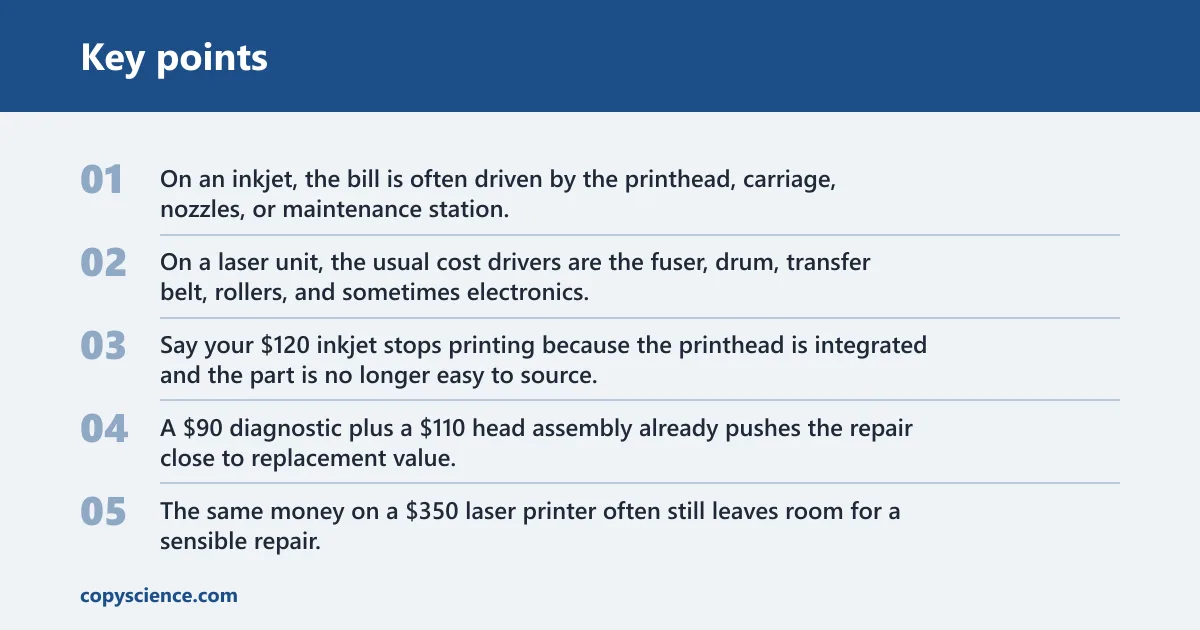
On an inkjet, the bill is often driven by the printhead, carriage, nozzles, or maintenance station. On a laser unit, the usual cost drivers are the fuser, drum, transfer belt, rollers, and sometimes electronics.
Say your $120 inkjet stops printing because the printhead is integrated and the part is no longer easy to source. A $90 diagnostic plus a $110 head assembly already pushes the repair close to replacement value. The same money on a $350 laser printer often still leaves room for a sensible repair.
Repair bill tipping point
A useful rule of thumb is to repair only if the estimate stays below about 40% of the replacement price. For a $100 printer, that means a $40 repair ceiling. For a $300 printer, it means about $120. That threshold helps separate a useful fix from a throwaway machine.
Warranty status changes the math fast. If parts and labor are covered, the decision leans toward repair. If the warranty excludes consumables and wear items, a fuser, drum, or printhead may still fall back on the owner.
What usually breaks first on an inkjet printer?
Inkjet printers usually fail first at the printhead, nozzles, carriage, or maintenance station. Infrequent use can increase clogging risk, and that can turn a simple cleaning issue into a more costly head or carriage repair. When the printhead is integrated, the machine can become a write-off sooner than owners expect.
Main inkjet failure points
- Printhead. This is the core inkjet component. It may be user-replaceable, or it may be built into the printer.
- Nozzles. Dried ink can block nozzles and create banding, missing colors, or repeated cleaning cycles that waste ink.
- Carriage. A worn or misaligned carriage can cause jams, noise, or poor print placement.
- Maintenance station. The capping and wiping system can fail to seal or clean the head correctly, which speeds up clogging.
Why printhead failures cost so much
The printhead is often the most expensive inkjet repair because it is the part that actually places ink. If the head is integrated, labor and part availability can make the repair cost approach the price of a new printer. If the head is separate and widely available, the repair is more reasonable.
A common first-timer mistake is to confuse cartridge replacement with a repair. A new cartridge is a consumable. A failed printhead is a repair item, and the cost jump can be dramatic.
What usually breaks first on a laser printer?
Laser printers often fail first at wear items like the fuser, drum, rollers, or transfer belt. They clog less often than inkjets, but their heat and feed parts age out. That makes the failure pattern different, not free of repair costs.
Main laser failure points
- Fuser assembly. This heating unit bonds toner to paper and wears from heat, pressure, and repeated duty cycles.
- Drum unit. In many models this is separate from toner and must be replaced on its own.
- Transfer belt. Larger machines may use a belt to move toner image layers to the page.
- Rollers and feed parts. Pickup rollers, separation pads, and guides wear over time and cause jams or skew.
Why laser repair bills stack up
Laser repairs often combine multiple wear parts in one visit. A fuser failure can expose worn rollers, and a drum replacement may be recommended at the same time. Add labor, and the total can move from “fixable” to “replace it” quickly on entry-level machines.
Printer repair cost table
This table separates true repair bills from consumable replacement costs. It uses a simple 40% repair threshold against the printer’s replacement price.
| Failure type | Likely parts involved | Typical cost tier | Replace-vs-repair recommendation for Inkjet | Replace-vs-repair recommendation for laser repair cost |
|---|---|---|---|---|
| Printhead clog/failure | Printhead, nozzles, carriage, maintenance station | Low to high, depending on whether the head is user-replaceable | Repair if the head is separate and the total stays under 40% of replacement price; replace if integrated and scarce | Not a common laser failure; if electronics mimic printhead symptoms, compare total bill to replacement price |
| Fuser failure | Fuser assembly, rollers, thermal sensors | Medium to high | Rare on inkjets, so a comparable heat-related failure often points to replacement instead | Repair if the printer is mid-tier or better and the total stays under 40% of replacement price |
| Drum wear | Drum unit, transfer parts | Low to medium | Not applicable in most inkjets | Repair if the drum is separate, inexpensive, and the model still has useful life left |
| Roller/feed problems | Pickup rollers, separation pads, feed tires, maintenance kit | Low to medium | Repair if parts are easy to source and the printer is not a budget model | Usually repairable, especially when a maintenance kit restores feed reliability for less than 40% of replacement price |
| Electronics failure | Control board, power supply, sensors | Medium to high | Repair only on newer or higher-value units; otherwise replace | Repair only when the board is available and the machine sits well above budget class |
Why labor changes the bill
Labor is often the hidden part of printer repair cost. Diagnostic fees, minimum bench charges, shipping both ways, and onsite service can add enough to change the decision even when the part itself is modestly priced. That matters most on low-cost printers.
Diagnostic and bench charges
A service shop may charge a diagnostic fee before any work starts, then a minimum bench charge once the unit is opened. Even if the part is cheap, that fixed labor floor can push a repair over the 40% threshold.
-
Get the estimate first. Ask for the diagnosis fee, part price, labor hours, and whether the shop charges a minimum. A small part plus a large bench charge can be a bad deal on a budget printer.
-
Add shipping or pickup. If the printer must be shipped, include outbound and return freight. On low-end machines, shipping alone can equal the cost of replacement.
-
Check onsite rates. Onsite service can be useful for larger business lasers, but travel time and service minimums raise the total quickly. That is why mid- to high-tier machines are easier to justify than cheap desktop units.
How much does it cost to fix a printer printer head versus a fuser?
A printer head repair usually ranges from inexpensive to very expensive depending on whether the head is user-replaceable and still available. A fuser repair is often in the medium-to-high range because it is a heat-based assembly with labor-heavy replacement steps. The cheaper fix is the one with easy part access and low labor.
Printhead, carriage, and maintenance station
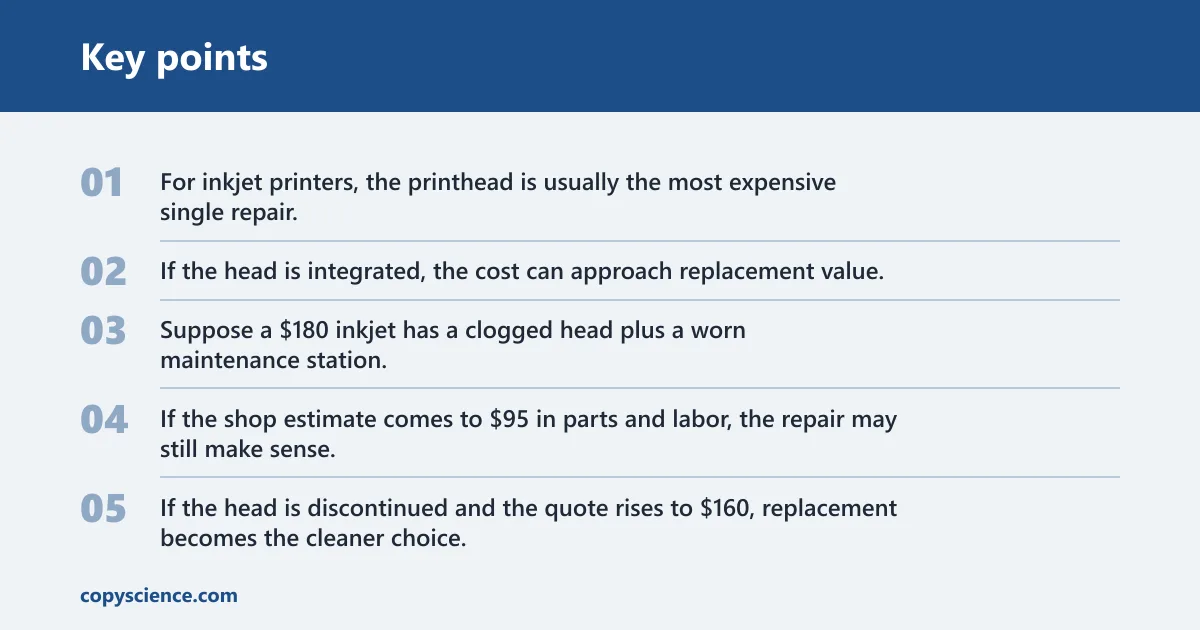
For inkjet printers, the printhead is usually the most expensive single repair. If the head is integrated, the cost can approach replacement value. Carriage and maintenance station repairs are often lower, but they still require diagnostic time and parts that may not be stocked for older models.
Suppose a $180 inkjet has a clogged head plus a worn maintenance station. If the shop estimate comes to $95 in parts and labor, the repair may still make sense. If the head is discontinued and the quote rises to $160, replacement becomes the cleaner choice.
Fuser, drum, rollers, and transfer parts
On laser printers, the fuser is the big-ticket wear item. A separate drum unit can add another line to the bill, and rollers or a transfer belt may be recommended at the same time. That stack of parts is why laser repair cost can rise faster than owners expect.
Laser printers are still often worth repairing when the model is used heavily and the replacement price is high enough. A $220 repair on a $700 workgroup laser can be reasonable. The same bill on a $130 home laser is much harder to justify.
Electronics failures on both types
Control boards and power supplies can fail on both inkjet and laser models. These repairs are often only worth it when the printer is relatively new, well built, or expensive to replace. On old or low-cost units, the electronics quote often becomes the tipping point toward replacement.
Choose Inkjet if… / Choose laser repair cost if…
Choose Inkjet if the printer is low-priced, the failure is a replaceable cartridge-adjacent or nonintegrated printhead issue, and the estimate stays under 40% of replacement price. Choose laser repair cost if the machine is mid- to high-tier, the failure is a wear part like a fuser or drum, and regular use makes the repair worth more than buying a new unit.
Choose Inkjet if…
- The printer is inexpensive to replace.
- The problem is a separate, available printhead or a simple feed issue.
- You print irregularly and want the lowest upfront purchase price.
- The repair quote stays well under the 40% threshold.
Choose laser repair cost if…
- The printer is mid-tier or higher.
- The failure is a fuser, drum, rollers, or transfer part.
- You print often enough that reliability and duty cycle matter.
- The repair estimate remains below the 40% replacement rule.
Should you repair or replace?
Repair if the estimate is under 40% of replacement price, the printer is still within warranty or has valuable remaining life, and the failed part is available. Replace if the printer is cheap, the printhead or fuser is integrated and scarce, or the shop bill includes heavy labor, shipping, or multiple wear parts.
Depreciation threshold rule
The 40% rule is a practical depreciation threshold. It is not a law, but it helps keep the decision tied to the actual value of the machine. A $60 repair on a $150 printer is borderline; a $60 repair on a $400 printer is usually easier to justify.
Warranty and age check
Warranty coverage matters because it may include parts and labor, while still excluding consumables and wear items. If the machine is older, discontinued, or already showing multiple symptoms, the repair bill is more likely to keep climbing.
-
Identify the failed part. Decide whether the issue is a cartridge, a printhead, a fuser, a drum, or an electronic board. Consumables are not the same as repairs.
-
Request the full quote. Ask for diagnostics, parts, labor, shipping, and any service minimum. Compare the total against the printer’s replacement price, not just the part price.
-
Apply the 40% rule. Repair only if the total stays below 40% of replacement price and the printer still fits your use pattern.
Frequently asked questions
Is it cheaper to repair an inkjet or a laser printer?
It depends on the failed part, but laser printers are usually cheaper to repair for major failures. Inkjets are often cheaper for simple fixable issues, yet an integrated printhead can make the repair uneconomical. Compare the full quote, not the part alone.
Should I replace my printer instead of repairing it?
Replace it when the repair estimate is above 40% of replacement price, the printer is old, or the failed part is scarce. Replacement also makes more sense when the machine has multiple worn parts or when shipping and labor push the total too close to a new unit.
What printer type is cheaper to own if repairs are likely?
If repairs are likely, laser printers can be cheaper to own in higher-use settings because wear parts are often repairable and the machine is built for duty cycle. For occasional use and low purchase price, inkjets can still be cheaper if you avoid printhead-heavy failures.