Inkjet vs Laser Cost If You Print Once a Week: Which Wins?

For once-a-week home printing, a basic monochrome laser is often the cheapest 3-year choice for text. An inkjet only wins if you print enough color to use the ink before it ages. Ignore idle-time waste and you can end up paying more for dried cartridges than for pages. This guide breaks down purchase price, consumables, and low-use waste into a realistic 3-year cost budget.
| Factor | Inkjet | laser cost if you print once a week | Winner |
|---|---|---|---|
| Upfront hardware | Usually lower at entry level. | Usually higher at entry level. | Inkjet |
| Low-use consumables | Liquid ink can dry during idle gaps, and cleaning cycles use ink before any page prints. | Dry toner is heat-fused to the page and does not evaporate. | laser cost if you print once a week |
| Text cost over 3 years | Can rise sharply if cartridges age before they are empty. | Usually lower for black-and-white pages. | laser cost if you print once a week |
| Color and photo output | Better fit for photos and color pages. | Works for color documents, but not the main strength. | Inkjet |
| Idle-time risk | Higher, because nozzle maintenance and evaporation matter. | Lower, because toner does not dry out. | laser cost if you print once a week |
3-year ownership cost table
This table uses a simple once-a-week model: about 1 page per week, about 52 pages per year, about 156 pages over 3 years, and about 6 idle days between sessions. The totals below are scenario estimates, not model-specific list prices. They separate hardware, consumables, and idle-time waste so you can see where low-use owners lose money.
| Scenario | Hardware | Consumables | Idle-time waste risk | Estimated 3-year total |
|---|---|---|---|---|
| Standard cartridge inkjet | $70 | $120 | $90 | $280 |
| Monochrome laser | $140 | $45 | $0 | $185 |
| Ink tank printer | $200 | $30 | $25 | $255 |
For the inkjet row, the consumables number assumes the printer is bought with standard cartridges, not an ultra-cheap starter setup that later forces expensive replacements. The idle-time waste line reflects cleaning cycles and partial ink loss from sitting unused between weekly sessions. The laser row stays low because dry toner is heat-fused and does not evaporate between jobs.
How the math works
The point of the table is not that every printer costs exactly those amounts. The point is that low-use ownership is a three-part bill: purchase price, pages printed, and time spent waiting between prints. For intermittent use, that last piece changes the ranking more than most product pages admit.
-
Start with the hardware price. Entry-level inkjets usually cost less at the register, while lasers often cost more up front. That can make the inkjet look cheaper on day one, even when it is more expensive by year three.
-
Add the page supply you will actually use. Cost per page matters, but only after you check whether the printer sits long enough for ink to age. A low nominal cost per page does not help if the cartridge is partly spent on maintenance.
-
Include idle-time waste. Cleaning cycles consume ink even when nothing is printed. If you print once a week, that hidden loss can be large enough to erase the advantage of a cheap starter inkjet.
-
Compare the 3-year total, not just the cartridge yield. Standard yield figures are measured under continuous printing, so a once-a-week owner should expect a lower real-world result than the package claims.
How idle time changes ink cost
Inkjet printers use liquid ink, so long gaps can dry nozzles and trigger cleaning cycles before the next job prints. That means you pay for ink that never reaches paper. Laser printers use dry toner fused by heat, so toner does not evaporate and idle gaps are far less expensive.
Cleaning cycles and wasted ink
Cleaning cycles are the hidden charge that low-use owners miss. The printer runs them to prevent nozzle clogging, but they consume ink that does not appear in your page count. For a once-a-week user, that makes the real cost per page higher than the cartridge math on the box.
Suppose a home printer sits 6 days between uses and asks for a cleaning pass before the next job. The page still looks like one print, but some of the ink budget went to maintenance. That is why low-volume buyers often see a higher effective cost than the printed yield suggests.
Why ISO/IEC 24711 can mislead low-use buyers
ISO/IEC 24711 is the cartridge yield standard, and it measures yield under continuous printing. That is useful for fair comparisons, but it can overstate what a once-a-week owner will get in practice. The more the printer sits, the more likely the real yield falls below the rated figure.
A common first-timer mistake is buying by the largest yield number alone. High-yield cartridges do extend page count and reduce replacement frequency, but they still lose efficiency if the printer sits idle and runs cleaning cycles. More pages per cartridge does not remove evaporation risk.
Inkjet, laser, and ink tank cost drivers
Inkjet printers lay liquid ink onto paper. Laser printers use dry toner fused to the page by heat. Ink tank printers use refillable reservoirs, and they sit between the two: lower per-page cost than standard cartridges, but still some idle-time evaporation risk.
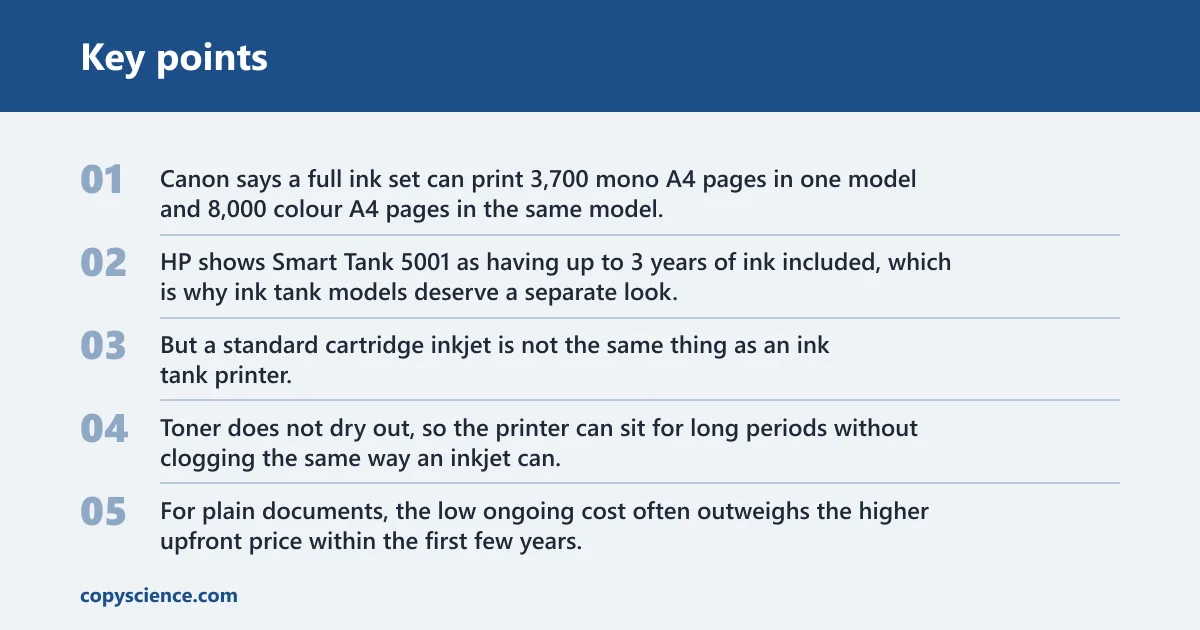
Canon says a full ink set can print 3,700 mono A4 pages in one model and 8,000 colour A4 pages in the same model. Canon also lists a laser model at 7,600 mono pages and 5,500 colour documents, and says high-yield toner is more efficient and cost-effective than using cartridges. Those figures help explain why toner often wins for text-heavy, low-use printing.
Standard cartridge inkjet
This is the weakest fit for once-a-week ownership. The low sticker price looks attractive, but standard cartridges have lower real-world yield at intermittent use, and cleaning cycles cut into the supply before many pages are printed. It is still the better choice if you care most about photos or color output.
HP shows Smart Tank 5001 as having up to 3 years of ink included, which is why ink tank models deserve a separate look. But a standard cartridge inkjet is not the same thing as an ink tank printer. They have different cost structures, and they should not be lumped together.
Monochrome laser
This is the most practical text printer for once-a-week use. Toner does not dry out, so the printer can sit for long periods without clogging the same way an inkjet can. For plain documents, the low ongoing cost often outweighs the higher upfront price within the first few years.
Canon’s contrast between single prints and larger runs matters here. If you only print short jobs, the laser’s steady black-and-white running cost is easier to control than the maintenance waste of a cartridge inkjet. That difference is why the 3-year total in the table is lower.
Ink tank printer
Ink tank printers can beat cartridge inkjets on running cost, and they are the better ink-based choice for low-use owners who still need color. The refillable reservoir lowers cost per page, but the printer still uses liquid ink, so idle-time evaporation remains part of the budget.
For a once-a-week user, an ink tank model can land between the two extremes. It is usually cheaper than a standard cartridge inkjet over 3 years, but a monochrome laser still tends to win for plain text.
Which printer type fits your print habits?
For one short session a week, the best choice depends on what you print, not just how much you print. A monochrome laser is usually cheapest for text. An inkjet is the better option only when your need for color or photos is high enough to consume ink before it ages.
Text-only pages
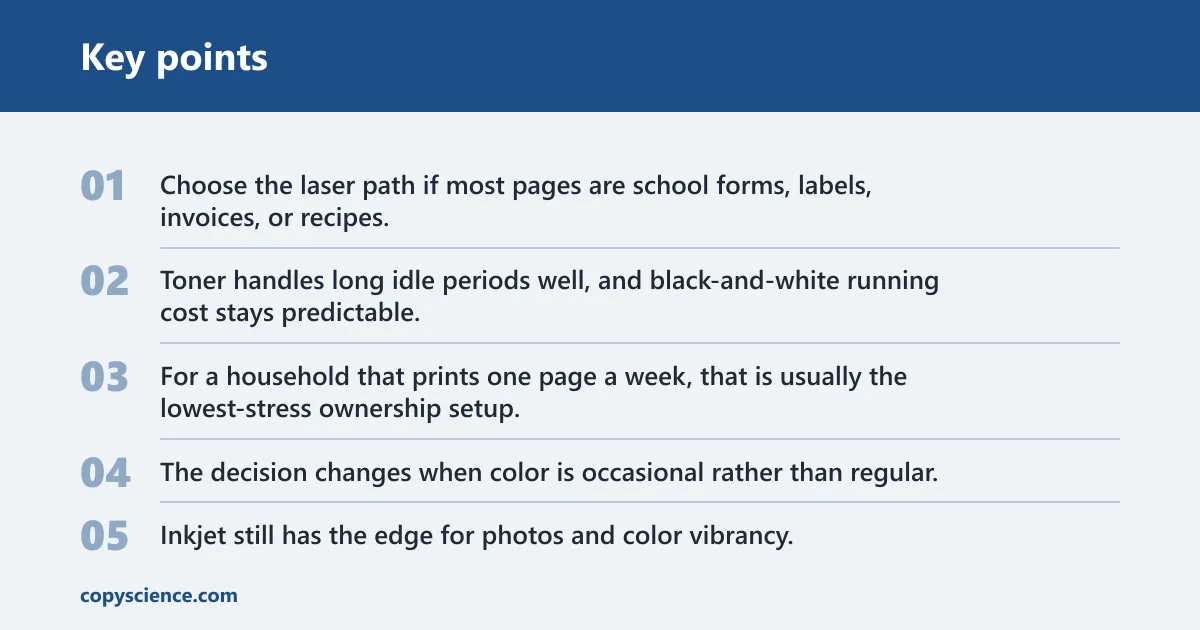
Choose the laser path if most pages are school forms, labels, invoices, or recipes. Toner handles long idle periods well, and black-and-white running cost stays predictable. For a household that prints one page a week, that is usually the lowest-stress ownership setup.
Mixed text and color
If you need color charts, handouts, or family documents, an ink tank printer usually makes more sense than a standard cartridge inkjet. It lowers the supply cost without bringing the laser’s color limitations into play. The decision changes when color is occasional rather than regular.
Photo-heavy printing
Inkjet still has the edge for photos and color vibrancy. If the goal is photo output, the extra maintenance risk may be worth it because the printer is doing the job it is best at. For occasional photo printing, though, an ink tank model usually ages better than a cartridge inkjet.
Picture a home office that prints one black-and-white page each Tuesday and a color school handout once a month. In that case, the black text pages still push the total toward a laser, unless the color pages are frequent enough to keep an ink tank in regular use. The purchase price alone will not settle it.
When the break-even point changes
The break-even point moves when page count rises, idle gaps get longer, or the hardware price changes. It also moves if you replace a clogged inkjet early, because replacement risk becomes part of ownership cost. That is why the same printer can be a bargain for one user and a mistake for another.
-
Raise the weekly page count. More pages dilute the effect of idle-time waste. Once a printer is used often enough, the running cost of an inkjet or ink tank becomes more important than its maintenance risk.
-
Lengthen the idle gap. Two or three weeks between print jobs makes nozzle drying more likely on cartridge inkjets. At that point, the effective cost per page rises faster than the simple yield number suggests.
-
Check the upfront price spread. If the laser costs much more than the inkjet, the break-even point pushes out. If the price gap is small, toner’s lower maintenance burden takes over sooner.
-
Factor in replacement risk. A cartridge inkjet that clogs repeatedly can cost more than the original purchase price over time. For low-use owners, that risk matters as much as the advertised cartridge yield.
Choose Inkjet if… / Choose laser cost if you print once a week if…
Choose Inkjet if your pages are mostly photos, color charts, or color-heavy school work, and you print often enough to use the ink before it sits for long. Choose laser cost if you print once a week if your pages are mostly text, you want the lowest 3-year ownership cost, or you do not want to worry about dried cartridges and cleaning cycles.
- Choose Inkjet if color and photo quality matter more than the lowest possible 3-year cost.
- Choose Inkjet if you will print often enough that cartridges do not sit idle for long.
- Choose laser cost if you print once a week if your main job is black text on plain paper.
- Choose laser cost if you print once a week if you want the cheapest practical printer to own over 3 years.
- Choose laser cost if you print once a week if you want to avoid maintenance waste between print jobs.
Frequently asked questions
Is an inkjet or laser printer cheaper if I print once a week?
A monochrome laser is often cheaper over 3 years for once-a-week text printing. The upfront price is often higher, but toner does not dry out and cleaning waste is minimal compared with a cartridge inkjet. An inkjet only pulls ahead if your color printing is frequent enough to use the ink efficiently.
How much ink does an inkjet waste if it sits idle between print jobs?
It varies by model and usage pattern, so there is no single number that fits every printer. The real cost comes from cleaning cycles and partial drying, both of which use ink without producing pages. That is why a weekly user often sees lower real-world yield than the cartridge rating suggests.
How long can a laser printer sit unused without drying out?
Laser printers do not use liquid ink, so drying out is not the same problem. Toner is dry and does not evaporate, which is why long idle periods are less of a concern. Other issues can still happen with any printer, but clogging from dried ink is mainly an inkjet problem.
What is the real cost per page for low-volume home printing?
For low-volume use, real cost per page should include consumables, hardware spread over time, and idle-time waste. ISO/IEC 24711 yield figures are useful, but they assume continuous printing and can overstate a once-a-week result. The real number is usually higher for cartridge inkjets and lower for lasers.
Do ink tank printers beat laser for low-use printing?
Ink tank printers often beat standard cartridge inkjets, but they do not automatically beat monochrome laser for once-a-week text. Their refillable reservoirs lower cost per page, yet idle-time evaporation still matters. They make the most sense when you need color and want lower running cost than cartridges.
How much should I budget over 3 years if I print 1 page a week?
Using the scenario table above, budget about $185 for a monochrome laser, $255 for an ink tank printer, and $280 for a standard cartridge inkjet. Those are illustrative totals built from hardware, consumables, and idle-time waste. The ranking changes if you print more often or need photos.