Inkjet vs Laser Cost for Tax Season: Cheapest Choice

For short bursts of annual paperwork, the cheapest choice is usually the printer you already own. A new monochrome laser often beats an inkjet only once you print about 500 to 1,500 black-and-white pages a year. Miss that break-even point and you can pay more through dried-out cartridges, wasted ink, or a laser setup that never earns back its purchase price. This guide shows how to compare inkjet and laser costs for tax forms, receipts, statements, and other once-a-year printing.
| Decision factor | Inkjet | laser cost for tax season and annual paperwork | Winner |
|---|---|---|---|
| Upfront device cost | Typically lower purchase price | Typically higher purchase price, especially for a basic mono model | Inkjet |
| Idle-period risk | Liquid ink can dry out or clog after long gaps | Toner powder has a longer shelf life and is less sensitive to long inactivity | laser cost for tax season and annual paperwork |
| Low-volume black text cost | Can rise fast after one cartridge replacement | Usually lower once the printer sees steady black-only pages | laser cost for tax season and annual paperwork |
| Best fit for one-time filing | Best when you already own it and the cartridge is healthy | Best when your inkjet is stale, empty, or expensive to revive | tie |
Inkjet vs laser for annual paperwork
For tax forms and annual filing, the real question is not which printer is cheaper on a shelf. It is which one costs less for a small burst of black-and-white pages after you count the printer you already own, the first replacement cartridge, and the risk that a long gap makes one machine wasteful.
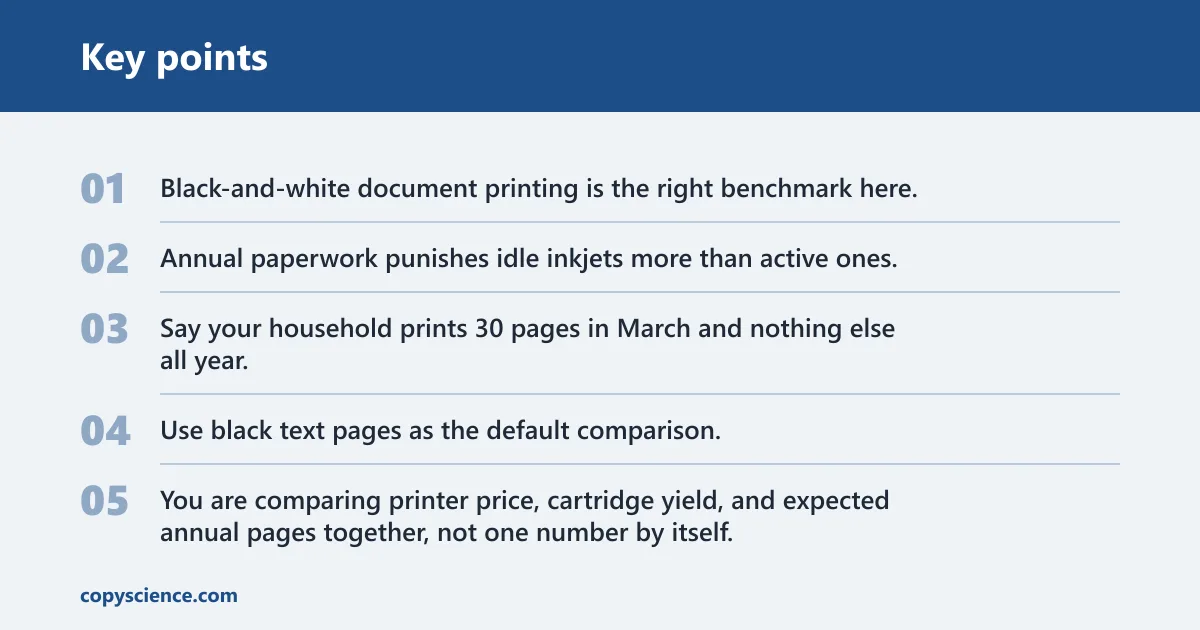
Black-and-white document printing is the right benchmark here. Tax returns, receipts, statements, and cover sheets use far less ink or toner than color-heavy home printing, so the economics hinge on page yield, cartridge age, and whether the machine has been sitting unused for months.
Why tax forms are a different use case
Annual paperwork punishes idle inkjets more than active ones. A cartridge with liquid ink can dry out, clog nozzles, or require cleaning cycles before the first useful page prints, while toner in a laser printer is far less sensitive to long storage. That changes the math at 20, 50, or 200 pages.
Say your household prints 30 pages in March and nothing else all year. A printer with a cheap sticker price can still be the pricier choice if the cartridge ages out before the next tax season and needs replacing again.
Black-and-white documents as the baseline
Use black text pages as the default comparison. Color pages consume more consumable material, so they make an inkjet look worse than it really is for filing, while also making a laser more attractive if you only need forms and scans as crisp monochrome output.
That is why cost per page matters more than headline device price. You are comparing printer price, cartridge yield, and expected annual pages together, not one number by itself.
Is inkjet or laser cheaper?
If you already own a working printer, inkjet can be the cheapest choice for a small annual stack of forms. If you are buying from scratch and expect repeated black-only use, a basic laser often pulls ahead because toner stores better and the per-page cost usually stays steadier at low-to-moderate volume.
The printer you already own
The cheapest printer is often the one on the desk. If the existing inkjet still prints cleanly and the cartridge is not near the end of its shelf life, replacing it just for tax season rarely pays back the purchase of a new machine.
Buy price versus running cost
A cheap printer can become expensive after one cartridge replacement. The trap is simple: device price is visible, while a stale cartridge, a cleaning cycle, or a short-yield replacement quietly pushes the true cost up.
Where break-even usually shifts
For many households, the break-even point moves into the hundreds of black-and-white pages per year before a laser starts to win decisively. Below that range, a usable existing printer often remains the lowest-cost option unless idle ink waste is forcing repeated cartridge buys.
How cartridge costs change the math
Cartridge yield and replacement timing can change the answer more than printer brand or body style. A cartridge rated for a certain page count spreads its cost across that yield, but low-coverage tax pages, cleaning cycles, and age-related waste can make the real cost per page higher than the label suggests.
Ink cartridge yield and idle-time risk
Ink cartridges are liquid consumables. They are common in inkjet printers, and they can dry out or clog after long inactivity, which means the first expense may be a replacement rather than a refill of routine pages.
Toner cartridge yield and shelf life
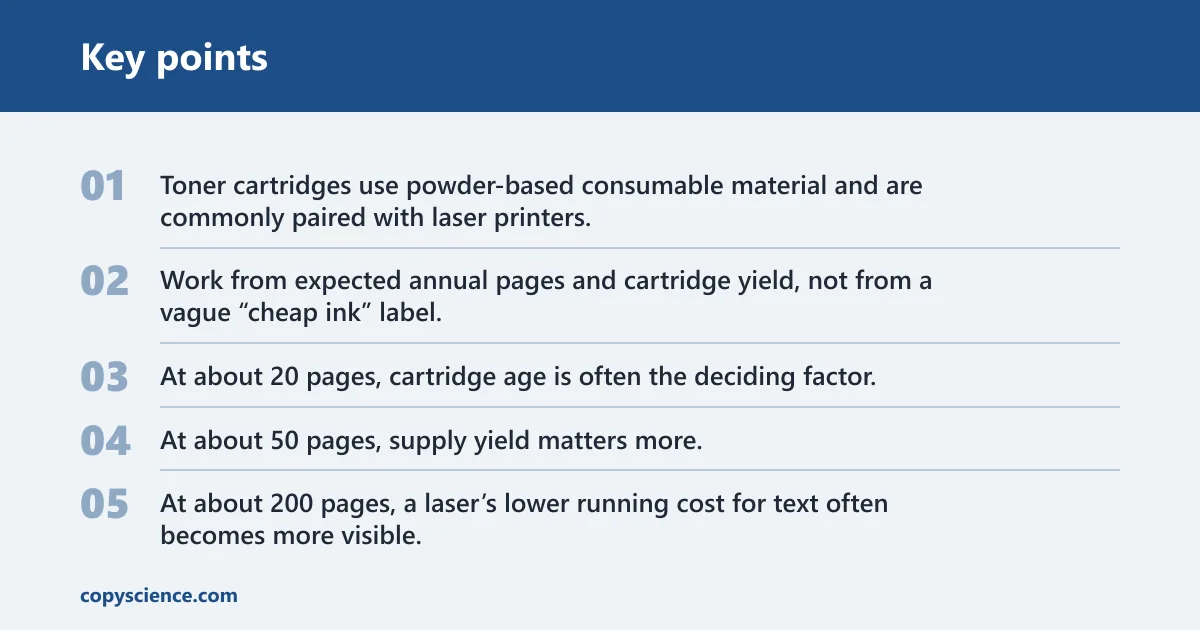
Toner cartridges use powder-based consumable material and are commonly paired with laser printers. Because toner has a long shelf life relative to liquid ink, rare-use printing tends to waste less supply between tax seasons, especially for black text documents.
Cost per page at 20, 50, and 200 pages
Work from expected annual pages and cartridge yield, not from a vague “cheap ink” label. At about 20 pages, cartridge age is often the deciding factor. At about 50 pages, supply yield matters more. At about 200 pages, a laser’s lower running cost for text often becomes more visible.
| Annual pages | Likely inkjet result | Likely laser result | Practical winner |
|---|---|---|---|
| 20 pages | Lowest only if the cartridge is already fresh | Often higher buy-in, but idle waste is low | Inkjet if owned and healthy |
| 50 pages | Can be cheap, but replacement timing starts to matter | More predictable for black-only filing | tie |
| 200 pages | Consumable cost can rise fast | Usually the better text-print economics | laser cost for tax season and annual paperwork |
Should you buy a laser printer just for tax season?
Only buy a laser printer for tax season if you expect repeated black-and-white use, your current inkjet is aging badly, or the ink replacement cost is already high enough that a budget laser pays back over a few seasons. For a single short burst, replacement ink or the existing printer is often cheaper.
When a budget laser makes sense
A used or budget laser can beat an idle inkjet when your printing is sparse but recurring, especially if your documents are mostly forms, statements, and receipts. The toner may cost more up front, but it usually avoids the waste tied to dried-out ink and repeated nozzle maintenance.
When replacing ink is cheaper
If the current printer already works and the ink cartridge is fresh, replacing that cartridge can be cheaper than buying another machine. That is especially true if you only print a few dozen pages and do not want to pay for a new device that spends the rest of the year unused.
When remanufactured or compatible cartridges fit the plan
Remanufactured cartridges and compatible cartridges can lower supply spending for occasional printing. Compatible cartridges are newly manufactured and filled with third-party ink or toner, while remanufactured cartridges are recycled through a 9-step process. Verify model match, print quality, and support terms before depending on them for filing deadlines.
-
Check your current cartridge age.
If the inkjet cartridge has sat through a long gap, estimate whether it will survive another tax season without clogging. A fresh cartridge lowers the chance that the cheapest printer becomes expensive only because of idle-time waste.
-
Estimate your annual pages.
Count likely black-and-white pages for forms, receipts, and copies. Use 20, 50, or 200 pages as a rough band, since that is enough to show whether device price or consumable cost matters more.
-
Compare replacement cost.
Look at cartridge yield and the price of an OEM, remanufactured, or compatible replacement. The lowest sticker price is not the lowest cost if the cartridge runs out halfway through the filing stack.
-
Buy only if payback is clear.
If a used laser or budget laser would be used every year and the inkjet is stale, a switch can make sense. If not, print with what you already own and avoid a device purchase that never earns itself back.
Can ink dry out after months of no use?
Yes. Ink cartridges can dry out or clog after months of inactivity, and that risk is often a main reason rare-use inkjet printing can cost more than expected. Toner cartridges are less sensitive to long gaps, so a laser usually carries less idle-period waste for annual paperwork.
Idle inkjet risk
When liquid ink sits too long, the printer may need cleaning cycles, nozzle checks, or replacement cartridges before it produces clean pages. That waste matters most when you only need a handful of pages and cannot afford wasted supply.
Picture a home office that prints 12 pages in April and nothing until the next spring. If the cartridge dries before then, the second season starts with a replacement cost instead of a low-cost print job.
Why toner is less sensitive to long gaps
Toner powder does not face the same drying problem, so a laser printer is usually better for rare black-text printing. That does not make laser automatically cheaper overall, but it does make the running cost more predictable when the printer sits unused for months.
Maintenance costs that matter for rare printing
Rare printing is where maintenance becomes part of the bill. Cleaning cycles, wasted starter ink, and replacement timing can outweigh the difference between a low-cost inkjet and a modest laser, especially when the annual page count stays small.
Annual paperwork cost worksheet
This worksheet compares three scenario bands: the printer already owned, a used or budget laser, and a new inkjet. Enter your own printer price, cartridge yield, expected pages, and idle-month replacement risk, then compare first-year cost with the cost per tax season.
| Scenario band | Inputs to use | First-year cost | Per-tax-season cost |
|---|---|---|---|
| Printer already owned | Printer price: $0; cartridge yield: your current cartridge; pages: 20, 50, or 200; idle-month replacement risk: low, medium, or high | Cartridge cost + any cleaning or replacement cost | Consumables only, unless idle risk forces a new cartridge |
| Used or budget laser | Printer price: purchase price; cartridge yield: toner rating; pages: 20, 50, or 200; idle-month replacement risk: low | Printer price + toner cost | Usually printer price spread over several filing seasons |
| New inkjet | Printer price: purchase price; cartridge yield: ink yield; pages: 20, 50, or 200; idle-month replacement risk: medium to high | Printer price + ink cost + idle waste risk | Can be low only if the cartridge stays fresh |
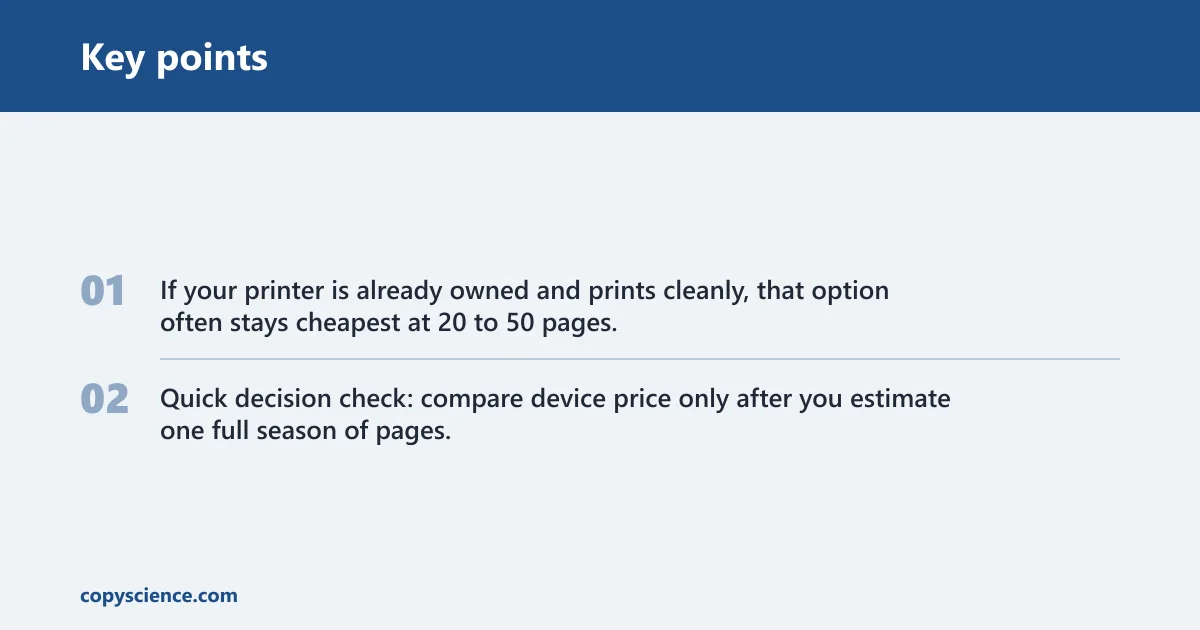
Worksheet rule: if your inkjet cartridge has been idle for months, add a replacement line to the cost before comparing it with laser. If your printer is already owned and prints cleanly, that option often stays cheapest at 20 to 50 pages.
Quick decision check: compare device price only after you estimate one full season of pages. Then add the consumable cost using rated yield, and increase the inkjet line if your cartridge is old enough to risk clogging.
Choose Inkjet if…
Choose Inkjet if you already own one, the cartridge is fresh, and your annual paperwork is only a short burst of black-and-white pages. It also fits better if you want a low-cost device for mixed home use and do not expect long idle periods between print jobs.
Choose laser cost for tax season and annual paperwork if…
Choose laser cost for tax season and annual paperwork if you print paperwork every year, your inkjet sits unused for long stretches, or your ink replacement costs are rising. A basic laser is the safer buy when you want predictable black-text printing and lower idle-period waste.
Frequently asked questions
Is inkjet or laser cheaper for printing tax documents once a year?
For once-a-year tax documents, the cheapest option is often the printer you already own. If you must buy new, a basic laser can be cheaper over time when inkjet cartridges are likely to dry out between seasons and force an extra replacement.
How much does a laser printer cost compared with an inkjet printer?
Inkjets usually cost less upfront, while laser printers usually cost more to buy. That difference matters only if you ignore consumables; a cheaper inkjet can still cost more after one or two replacement cartridges, especially if the printer sits unused for months.
Which printer has the lowest cost per page for occasional black-and-white printing?
For occasional black-and-white printing, a laser printer often has the lower cost per page once you include toner yield and lower idle waste. But if your inkjet is already owned and the cartridge is fresh, its effective cost can stay lower for a small annual batch.
Does ink dry out if I only print a few times a year?
Yes. Liquid ink can dry out or clog after long inactivity, which can force cleaning cycles or a new cartridge before useful pages print. That is why rare-use inkjet printing often costs more than the first purchase price suggests.
Are toner cartridges cheaper to store than ink cartridges for rare use?
Usually yes, because toner has a longer shelf life relative to liquid ink. That makes toner better suited to rare use, especially for black text documents, where the main risk is not drying but the upfront cost of the printer and cartridge.
Is a remanufactured cartridge worth it for occasional printing?
It can be, if compatibility and print quality check out. Remanufactured cartridges can reduce consumable spending, but they still need to match the printer model correctly and produce clean output when you need a tax form or receipt printed on deadline.