Inkjet vs Laser Cartridge Cost: Refill Spend

Inkjet cartridges usually cost less to buy, while laser toner often costs less per page once you print regularly; at 100+ pages a month, laser often needs fewer replacements. If you guess wrong, you can spend too much on refills or swap cartridges far more often than expected. This guide compares refill costs at low, medium, and high print volumes for home and office buyers.
| Factor | Inkjet | laser cartridge cost | Winner |
|---|---|---|---|
| Upfront purchase price | Basic models can cost under ₹2,000. | Higher entry price, especially for colour models. | Inkjet |
| Black-and-white refill cost per page | ₹1.5 to ₹4 | ₹0.5 to ₹1.5 | laser cartridge cost |
| Colour refill cost per page | ₹4 to ₹10 | ₹5 to ₹15 | Inkjet |
| Idle-time reliability | Nozzles can clog if unused for weeks. | Toner is a dry powder and generally does not dry out. | laser cartridge cost |
| Low-volume ownership cost | Fewer pages can mean slow cartridge turnover, but ink can still dry out. | More stable for long gaps between print jobs. | laser cartridge cost |
Inkjet vs laser at a glance
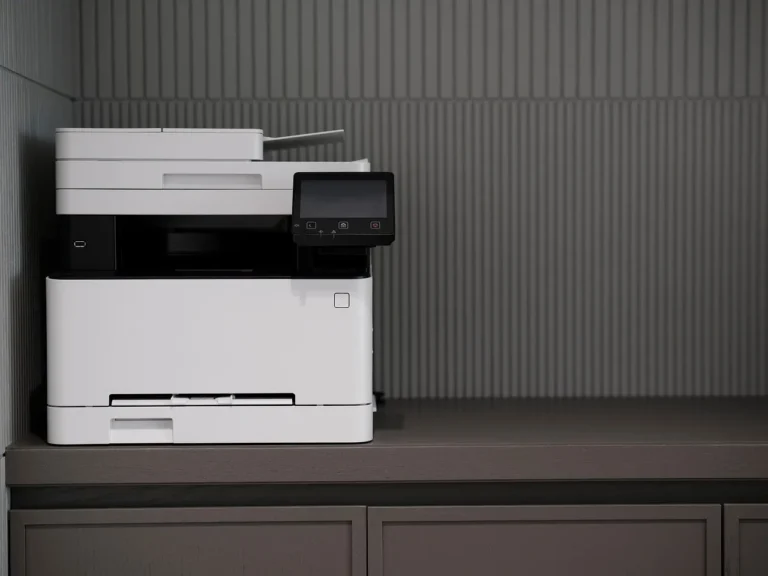
Inkjet printers push liquid ink through a printhead. Laser printers use dry toner and heat it onto the page. The money difference is plain: inkjet usually costs less to buy, while laser often costs less per page for black text, especially as your monthly page count rises.
How the two printing systems differ
Ink cartridges hold liquid ink, so the printer has to keep the nozzles clear. Toner cartridges hold dry powder, which stays usable longer between jobs. That matters for ownership cost because idle ink can dry out, while toner usually stays ready after long gaps.
Why refill spend is the real comparison
Purchase price is only one part of the bill. Refill spend depends on page yield, how many black and colour pages you print, and how often you replace cartridges over a year. A printer that looks cheap at checkout can become expensive if it burns through refills quickly.
Where purchase price fits into the decision
Basic inkjet printers can cost under ₹2,000. Laser printers have a higher entry price, especially colour models. That lower entry cost makes inkjet easier to buy, but it does not automatically make it cheaper to own if you print a lot.
Cartridge refill matrix
This matrix turns cartridge prices and page yields into monthly and annual spend. The figures below use the supplied price and yield ranges, so the result is a model, not a single universal bill. The break-even note under each use case shows the direction of travel.
| Use case | Inkjet black monthly / annual | Inkjet colour monthly / annual | Laser mono monthly / annual | Laser colour monthly / annual | Short break-even note |
|---|---|---|---|---|---|
| 25 pages/month | ₹37.50 to ₹100 / ₹450 to ₹1,200 | ₹100 to ₹250 / ₹1,200 to ₹3,000 | ₹12.50 to ₹37.50 / ₹150 to ₹450 | ₹125 to ₹375 / ₹1,500 to ₹4,500 | Laser is usually cheaper for black text; inkjet can still suit light colour use if you print rarely. |
| 100 pages/month | ₹150 to ₹400 / ₹1,800 to ₹4,800 | ₹400 to ₹1,000 / ₹4,800 to ₹12,000 | ₹50 to ₹150 / ₹600 to ₹1,800 | ₹500 to ₹1,500 / ₹6,000 to ₹18,000 | Laser usually pulls ahead for regular black-and-white printing because each toner cartridge lasts longer. |
| 300 pages/month | ₹450 to ₹1,200 / ₹5,400 to ₹14,400 | ₹1,200 to ₹3,000 / ₹14,400 to ₹36,000 | ₹150 to ₹450 / ₹1,800 to ₹5,400 | ₹1,500 to ₹4,500 / ₹18,000 to ₹54,000 | Laser has the clearest cost advantage here for text-heavy output; colour laser still carries a high refill bill. |
Black inkjet cartridge spend
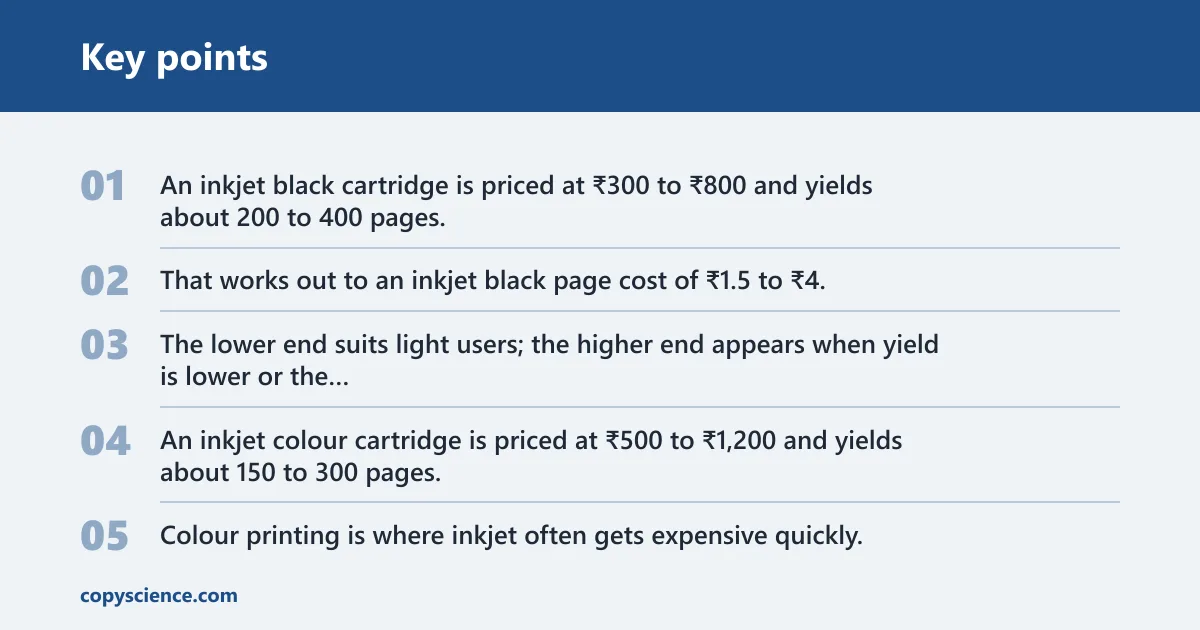
An inkjet black cartridge is priced at ₹300 to ₹800 and yields about 200 to 400 pages. That works out to an inkjet black page cost of ₹1.5 to ₹4. The lower end suits light users; the higher end appears when yield is lower or the cartridge is priced toward the top of the range.
Colour inkjet cartridge spend
An inkjet colour cartridge is priced at ₹500 to ₹1,200 and yields about 150 to 300 pages. That gives a colour page cost of ₹4 to ₹10. Colour printing is where inkjet often gets expensive quickly, because the yield is lower and each replacement may be needed more often.
Mono laser toner spend
A black laser toner cartridge costs ₹800 to ₹2,500 and yields about 1,500 to 5,000 pages. That gives a black-and-white page cost of ₹0.5 to ₹1.5. For black text, laser usually wins on refill cost once you print regularly, especially above the occasional-use level.
Colour laser toner spend
A laser colour toner set costs ₹5,000 to ₹15,000 and yields about 1,000 to 3,000 pages. That produces a colour page cost of ₹5 to ₹15. Colour laser is often the priciest refill path in this comparison, even if the printer is fast and reliable for documents.
What is the cost per page?
Cost per page is the clearest way to compare refill spend. For black-and-white pages, inkjet runs about ₹1.5 to ₹4 and laser about ₹0.5 to ₹1.5. For colour pages, inkjet runs about ₹4 to ₹10 and laser about ₹5 to ₹15, so the winner changes by use case.
Black-and-white page cost
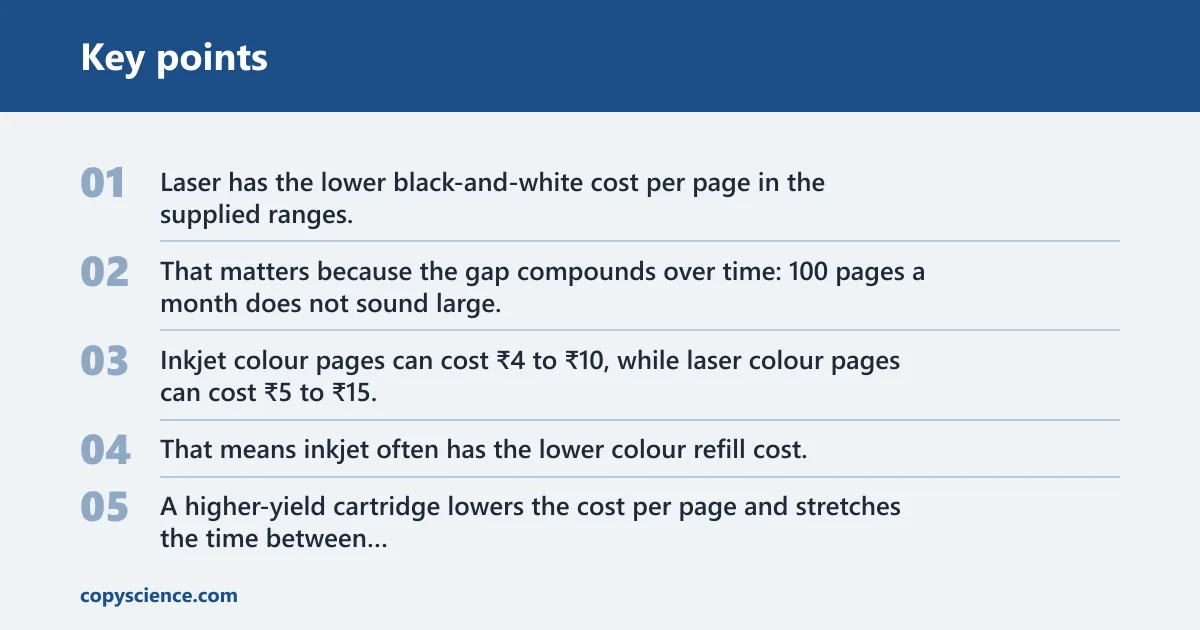
Laser has the lower black-and-white cost per page in the supplied ranges. That matters because the gap compounds over time: 100 pages a month does not sound large, but a difference of even ₹1 per page becomes ₹100 a month, or ₹1,200 a year.
Colour page cost
Colour is less clear-cut. Inkjet colour pages can cost ₹4 to ₹10, while laser colour pages can cost ₹5 to ₹15. That means inkjet often has the lower colour refill cost, but the exact result depends on the cartridge or toner set you buy.
How page yield changes the math
Yield drives the refill cycle. A higher-yield cartridge lowers the cost per page and stretches the time between replacements. That is why two printers with similar upfront prices can have very different annual refill bills.
Where high-yield cartridges cut the rate
High-yield variants lower the effective refill rate because you buy replacements less often. The principle is simple: more pages per cartridge means fewer purchases across the year. The exact savings depend on whether the high-yield option raises the cartridge price more slowly than it raises page yield.
How many pages do cartridges print?
The wider toner yield range is still far higher than typical inkjet yields.
Typical inkjet page yield
Inkjet yields are lower because the cartridge holds liquid ink in a smaller supply. That means more frequent replacements, especially if you print both text and colour. The replacement cycle becomes noticeable even at moderate volume.
Typical toner page yield
Toner cartridges last much longer because they are built around dry powder and larger page counts. That makes them a better fit for steady document printing. Fewer replacements also mean less chance of running out during a busy stretch.
High-yield variants and what they change
High-yield cartridges can reduce cost per page, but the same basic pattern remains: laser still tends to last longer for text, while inkjet colour can stay competitive for lighter colour work. If you print often, a high-yield version is worth checking before you compare printer models.
Why colour yields are often lower in practice
Colour printing uses more than one channel of consumable. On inkjet, colour cartridges can empty faster than black because many documents use mixed graphics or photos. On laser, colour sets are expensive to replace, so the refill bill grows quickly even when the page count is modest.
Does ink or toner age better?
Toner ages better between print jobs because it is dry powder and does not dry out. Inkjet cartridges can clog if the printer sits unused for weeks. That difference matters most for occasional users, because a cheap printer can still become costly if idle drying forces extra cleaning or replacement.
Nozzle clogging and idle drying risk
Inkjet nozzles can clog if the printer is unused for weeks. The supplied fact does not give an exact cutoff, so the safe reading is simple: long idle periods raise the risk. That can add indirect cost through wasted ink, cleaning cycles, or earlier replacement.
Why toner handles long gaps better
Toner is dry powder, so it does not dry out in the same way liquid ink can. That makes laser a better choice for long idle periods or occasional document printing. The consumable stays ready even when the printer sits unused for stretches.
Maintenance cost impact for occasional users
For occasional home use, the hidden cost is not only refill price. It is also the chance that ink dries in the nozzles before the cartridge is empty. If you print a few pages every few weeks, that reliability difference can matter as much as the per-page math.
Ink tank printers
Ink tank printers use refill bottles instead of sealed cartridges, and that changes the economics. They usually cost more than basic cartridge inkjets, but the refill bottles can deliver thousands of pages. For high colour volume, they can beat cartridge inkjets on running cost.
Refill bottle cost versus cartridge cost
Refill bottles spread ink across many more pages than a standard cartridge. That lowers the effective cost per page. The trade-off is a higher upfront purchase price than a basic cartridge inkjet, so the savings show up over time rather than at checkout.
Thousands of pages per refill set
Ink tank systems are built for very high page counts per refill set, often in the thousands. That scale is why they are attractive for mixed colour printing. The refill cycle is much less frequent than with cartridge-based inkjets.
When ink tanks beat cartridge inkjets
If you print regularly and use a lot of colour, ink tanks often make more sense than a cartridge inkjet. They are usually the better cost choice once refill frequency starts to matter more than the lowest possible entry price.
Choose Inkjet if… / Choose laser cartridge cost if…
Choose Inkjet if you want the lower entry price, print mostly photos or colour graphics, and do not need the printer to sit unused for long stretches. It also fits light home use when low upfront cost matters more than the lowest refill cost.
Choose laser cartridge cost if you print black text regularly, want fewer cartridge changes, or leave the printer idle for weeks at a time. It is the stronger choice for mixed office use and for anyone who wants lower black-and-white cost per page over the life of the printer.
- Occasional home use: pick inkjet only if the lower purchase price matters more than long-idle reliability.
- Regular black text: pick laser cartridge cost if your monthly pages are steady and mostly monochrome.
- Mixed colour documents: compare colour page cost before you buy; inkjet often looks better on paper, but colour toner can be expensive to refill.
- Higher-volume printing: consider an ink tank printer first if colour jobs are frequent and refill spend is the main concern.
Frequently asked questions
How much does an inkjet cartridge cost to refill?
The refill spend depends on whether you print black text or colour pages, because the page yield is different for each cartridge type.
How much does a laser toner cartridge cost to refill?
The colour set is much more expensive, but toner also lasts far longer than an ink cartridge in pages per refill.
Is inkjet or laser cheaper to refill over time?
Laser is usually cheaper over time for black-and-white printing because its page cost is ₹0.5 to ₹1.5, versus ₹1.5 to ₹4 for inkjet. For colour, the answer is less settled, since inkjet colour can cost ₹4 to ₹10 and laser colour can cost ₹5 to ₹15.
How many pages does an inkjet cartridge print?
Colour yield is usually lower, so colour-heavy printing leads to more frequent cartridge changes.
How many pages does a toner cartridge print?
That higher yield is a major reason laser often costs less per page for document printing.
Do inkjet cartridges dry out if not used often?
Yes. Inkjet nozzles can clog if the printer is unused for weeks, which can raise real ownership cost for occasional users. Toner does not dry out in the same way, so laser is usually safer for long idle periods.