Inkjet vs Laser Cost: How Price Spikes Change Value

After cartridge price spikes, a mono laser often costs less to run than a cartridge-based inkjet once you print roughly 50 to 100 pages a month. Very light use or photo-heavy printing can still favor inkjet. Ignore that shift, and you can pay far more per page than the printer seemed to cost. This guide shows how ink and toner inflation changes total cost, and how to recalculate the break-even point for home and small-office volumes.
| Factor | Inkjet | laser cost before and after price spikes | Winner |
|---|---|---|---|
| Running cost after inflation | Ink cartridges rose fastest in this model, so cost per page climbs quickly unless you move to high-yield or third-party supplies. | Toner also rises, but the higher page yield spreads the increase over more pages. | laser cost before and after price spikes |
| Color and photo output | Usually the better fit for color documents and photo output. | Usually the better fit for text and simple pages; color models cost more to run. | Inkjet |
| Low-volume ownership cost | Can stay competitive if you print rarely and care more about purchase price than page cost. | Often wins once monthly volume rises because each page costs less to feed. | laser cost before and after price spikes |
Running cost after inflation
Cartridge inflation hits both categories, but it hurts inkjet faster because ink cartridges usually carry less page yield. Each price jump shows up sooner in cost per page. High-yield ink, compatible cartridges, and remanufactured supplies can soften the increase, but they do not erase it.
Color and photo output
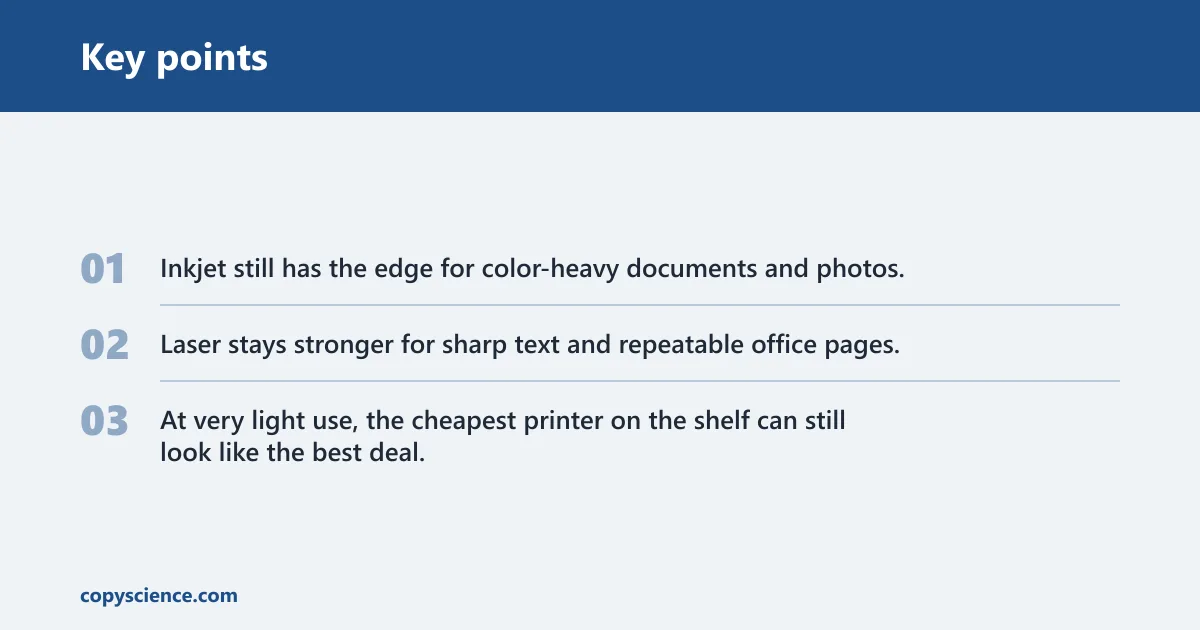
Inkjet still has the edge for color-heavy documents and photos. Canon says dye-based inks are more affordable and suit color vibrancy, while pigment-based inks are versatile and work on a range of media. Laser stays stronger for sharp text and repeatable office pages.
Low-volume ownership cost
At very light use, the cheapest printer on the shelf can still look like the best deal. That changes when the replacement cycle starts showing up every few weeks. Once you print enough to replace cartridges regularly, the lower page cost of laser usually matters more than a small upfront savings.
Is inkjet still cheaper after price spikes?
Sometimes, but not by default. If you print a few pages a month and want photos, an inkjet can still make sense. Once you move into steady monthly printing, the cost gap usually shifts toward laser because toner covers more pages per cartridge, even after inflation.
A practical read: the cheapest printer on the shelf can still look like the best deal, but it may not stay the cheapest printer to own. If you buy an inkjet for its low sticker price, then replace cartridges often, supply cost can overtake the savings from the lower purchase price.
Purchase price versus running cost
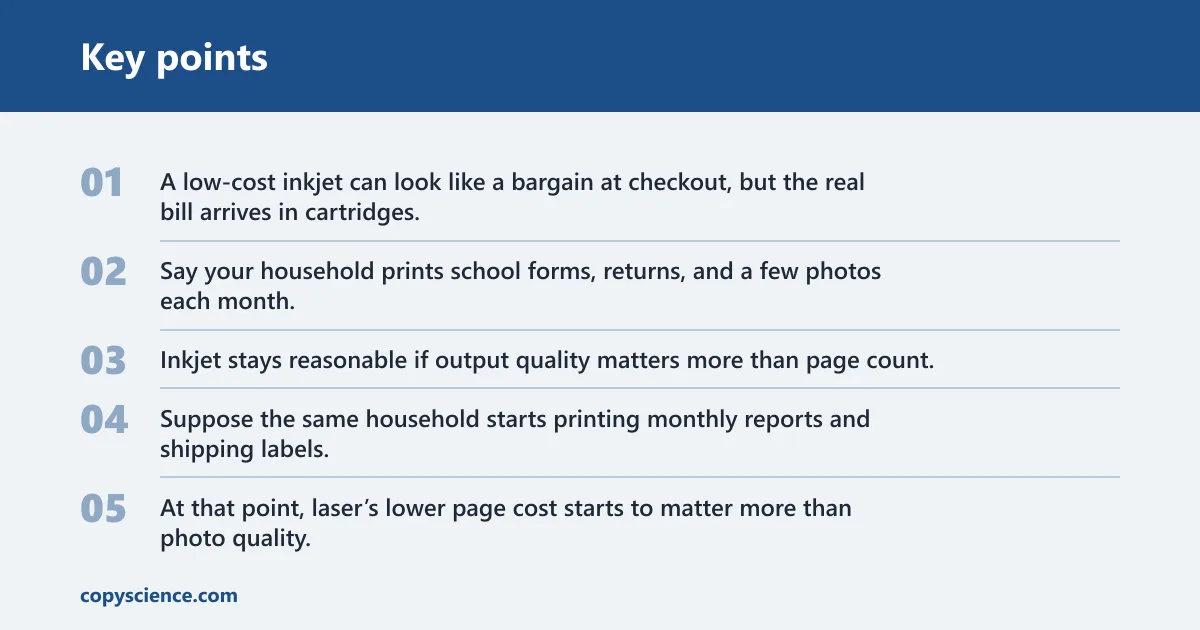
For home buyers, the trap is simple. A low-cost inkjet can look like a bargain at checkout, but the real bill arrives in cartridges. A more expensive laser can repay that extra upfront cost if you print enough text pages to spread toner across a larger volume.
Color and photo output versus text-heavy use
Say your household prints school forms, returns, and a few photos each month. Inkjet stays reasonable if output quality matters more than page count. Suppose the same household starts printing monthly reports and shipping labels. At that point, laser’s lower page cost starts to matter more than photo quality.
Ink and toner break-even table
This table uses a simple model to show how a supply price spike changes page cost. Assumptions: standard ink uses an HP 68 Black Original Ink Cartridge at $26.92; high-yield ink uses higher-capacity OEM ink at a modeled $48.99; compatible or remanufactured ink uses a modeled $27.99 supply; toner uses modeled standard, high-yield, and compatible/remanufactured prices. The page yields below are the assumptions for this comparison, so the math is visible.
| Supply type | Price before spike | Price after spike | Assumed yield | Cost per page before | Cost per page after |
|---|---|---|---|---|---|
| Standard ink cartridge | $26.92 | $33.65 | 150 pages | $0.179 | $0.224 |
| High-yield ink cartridge | $48.99 | $61.24 | 600 pages | $0.082 | $0.102 |
| Compatible or remanufactured ink | $27.99 | $34.99 | 450 pages | $0.062 | $0.078 |
| Standard toner cartridge | $80.00 | $100.00 | 2,000 pages | $0.040 | $0.050 |
| High-yield toner cartridge | $105.00 | $131.25 | 4,000 pages | $0.026 | $0.033 |
| Compatible or remanufactured toner | $60.00 | $75.00 | 3,000 pages | $0.020 | $0.025 |
50 pages per month
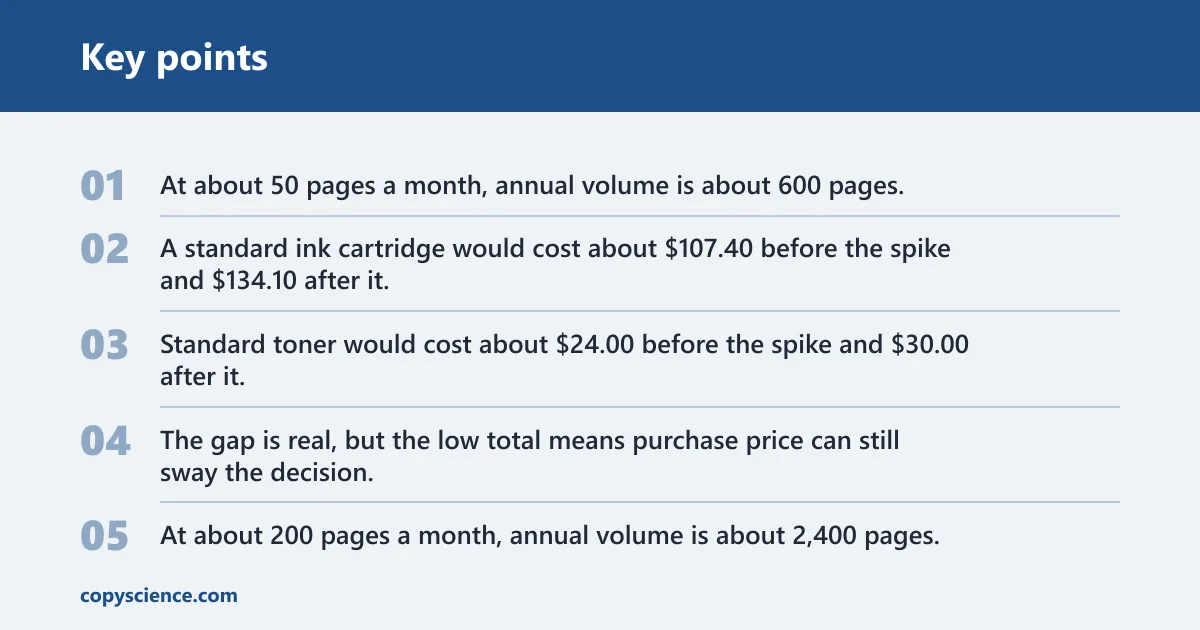
At about 50 pages a month, annual volume is about 600 pages. A standard ink cartridge would cost about $107.40 before the spike and $134.10 after it. Standard toner would cost about $24.00 before the spike and $30.00 after it. The gap is real, but the low total means purchase price can still sway the decision.
200 pages per month
At about 200 pages a month, annual volume is about 2,400 pages. Standard ink rises to about $429.60 before the spike and $537.60 after it. Standard toner lands around $96.00 before the spike and $120.00 after it. The cost spread becomes wide enough that a higher upfront laser price can pay back quickly.
1,000 pages per month
At 1,000 pages a month, annual volume is 12,000 pages. Standard ink reaches about $2,148.00 before the spike and $2,685.00 after it. Standard toner comes in around $480.00 before the spike and $600.00 after it. Heavy use makes cartridge inflation hard to ignore.
How the break-even point moves
Before the spike, a cheaper inkjet can hold the lead for light use. After the spike, the payback period for a laser shortens because each printed page saves more money. If the printer price gap is modest, a medium-volume user can recover it within the first year. If the gap is large, the break-even point moves out.
The key is simple: compare the price gap between printers with the yearly supply savings. If the savings are larger than the extra upfront cost, the more expensive printer wins over time. If not, the cheaper purchase still makes sense.
Do high-yield, compatible, or remanufactured supplies change the result?
Yes. High-yield cartridges lower cost per page because the price is spread across more pages, and compatible or remanufactured supplies can push running costs lower again. They do not make inkjet or laser identical, but they can move the break-even point enough to change the buying decision.
Standard cartridges versus high-yield cartridges
High-yield versions reduce the pain of price spikes because each replacement lasts longer. That matters most if you print enough to burn through standard cartridges quickly. Inkjets.com lists an HP 61XL high-yield 3-pack combo at $48.99, an HP 62XL high-yield 2-pack combo at $59.49, an Epson 252XL high-yield 9-pack combo at $49.99, and an HP 950XL & 951XL 4-pack combo at $27.99.
OEM versus compatible cartridges
OEM supplies are the original brand cartridges. Compatible cartridges are newly made third-party replacements filled with third-party ink or toner. Inkjets.com sells compatible and remanufactured cartridges for both ink and toner, and that matters because third-party supplies often lower the replacement cost that drives the whole comparison.
Remanufactured cartridges and when they help
Remanufactured cartridges use a recycled genuine housing that goes through a refurbishment process before being refilled and tested. They can be a strong option when you want lower running costs without moving to a tank printer. They make the most sense when your printer is otherwise healthy and you print often enough that supply cost matters.
Where ink tank printers fit
Ink tank printers are the main hedge against ink inflation. They remove the usual cartridge pattern and replace it with refill bottles, so recurring ink cost drops sharply. A Walmart listing puts the HP Smart Tank 5102 cartridge-free ink tank printer at $169.00, which is higher up front than low-cost cartridge models such as the HP DeskJet 2952 color inkjet printer at $44.00 and the Brother Work Smart MFC-J1260W inkjet printer at $60.00.
-
Check monthly page count.
Estimate how many pages you print in a typical month, then multiply by 12. The higher the volume, the faster cartridge inflation changes the answer. -
Compare supply type.
Look at standard, high-yield, compatible, and remanufactured options for your exact model. HP 68, HP 61XL, and HP 950XL examples show how price changes by supply size and package format. -
Match the printer to output.
Choose inkjet if color and photos matter most. Choose laser if text and steady volume matter more. -
Price the ownership gap.
Compare the printer’s upfront price with the yearly supply cost. If a laser saves more in toner than its higher purchase price, the long-term answer changes. -
Consider a tank printer.
If you print often and want a hedge against ink inflation, compare the tank model’s upfront price with the cartridge printer’s annual supply cost. The higher initial spend may pay back sooner than expected.
Choose Inkjet if… / Choose laser cost before and after price spikes if…
Choose Inkjet if you print lightly, want better color or photo output, and expect to use high-yield, compatible, or remanufactured supplies to keep page cost down. Choose laser cost before and after price spikes if you print text regularly, want lower cost per page after cartridge inflation, or expect your monthly volume to stay above the occasional-use range.
- Inkjet: best for color documents, photos, and lower page counts.
- Inkjet: also fits buyers who can tolerate higher supply cost in exchange for a lower upfront printer price.
- laser cost before and after price spikes: best for text-heavy work, steady monthly printing, and faster payback once supplies start adding up.
- laser cost before and after price spikes: also fits users who want cost per page to stay lower after toner prices rise.
Frequently asked questions
How much do replacement ink cartridges cost compared with toner cartridges?
Ink cartridges often cost less at checkout than toner cartridges, but they usually yield fewer pages. That means the cost per page can run higher, especially after a price spike. Toner often looks more expensive per cartridge yet cheaper over time because one cartridge covers more pages.
Does monthly print volume change which printer is better value after price spikes?
Yes. Low volume can still favor a cheap inkjet, especially if you print color or photos. As volume rises, toner’s lower page cost usually takes over. The more pages you print each month, the faster supply inflation shifts the math toward laser or ink tank printers.
Which printer costs less to own for low-volume printing right now?
For very light printing, the lower purchase price of a basic inkjet can still win, especially if you print only a few pages at a time. But if your cartridges dry out or need frequent replacement, the cheap printer can stop being the cheap choice. Running cost still matters more than sticker price alone.
Which printer is cheaper for color printing after price increases?
For color and photos, inkjet usually remains the better fit, but “cheaper” depends on how much you print. If you print only a little color, inkjet can stay reasonable. If you print a lot of color pages, an ink tank printer may be the better inflation hedge because its recurring supply cost is lower.
Should I buy an inkjet, laser, or ink tank printer to beat inflation?
Buy an inkjet if you print rarely and want color quality. Buy laser if you print text often and care about lower page cost after cartridge prices rise. Buy an ink tank printer if you print enough to feel cartridge inflation but still need color output and want the lowest recurring ink cost.
Are there cheaper alternatives to standard ink cartridges after inflation?
Yes. High-yield cartridges lower cost per page, and compatible or remanufactured supplies can lower it further. Inkjets.com sells compatible and remanufactured cartridges for both ink and toner, which gives budget buyers more room to cut running cost without changing printers right away.