Printer Ink vs Toner Cost: Which Is More Affordable Long Term?

Printer ink is usually cheaper only for very low-volume use; if you print about 100 pages a month or more, a toner printer often becomes the lower-cost choice over time because its per-page cost is typically lower. Skip that break-even point and you can spend more on cartridges than on the printer itself. This guide shows a simple break-even formula and maps it to low-, medium-, and high-volume home printing.
| Decision factor | Printer ink | toner cost | Winner |
|---|---|---|---|
| Upfront printer price | Usually lower, so the first purchase is easier to absorb. | Usually higher, especially for faster text-focused models. | Printer ink |
| Per-page cost at 5% coverage | Higher once you factor cartridge replacement frequency. | Lower because toner cartridges generally yield more pages. | toner cost |
| Low-volume printing | Often cheaper across three years if you print only a few pages a month. | Can cost more because the higher printer price takes longer to repay. | Printer ink |
| Text-heavy home office use | Works, but running cost climbs faster as volume rises. | Usually the better fit for repeated black-and-white pages. | toner cost |
| Photo and color-heavy use | Usually better for occasional color graphics and photos. | Less attractive for photo output and mixed color pages. | Printer ink |
Printer ink vs toner cost at a glance
Inkjet printers use liquid ink that sprays onto paper. Laser printers use toner powder that fuses to the page with heat. That difference drives the long-term trade-off: inkjets usually cost less to buy, while lasers often cost less per page after you add cartridge replacements, yield, and the months of printing you actually do.
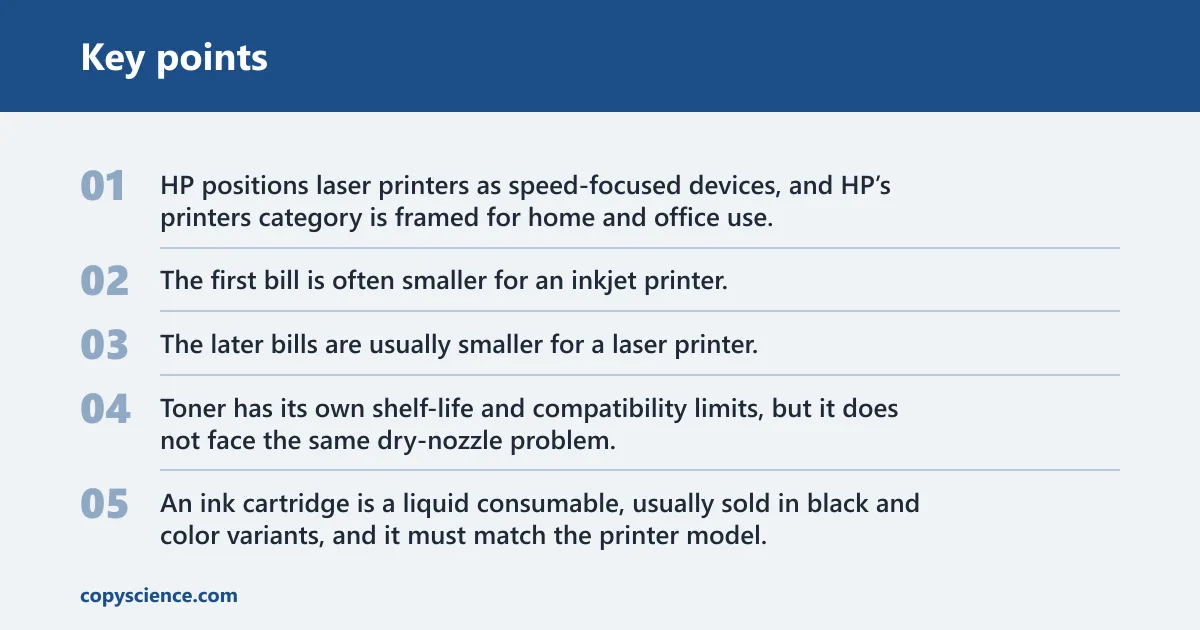
HP positions laser printers as speed-focused devices, and HP’s printers category is framed for home and office use. HP also groups original supplies as ink and toner, and it describes those supplies as engineered around quality and sustainability. Those are product-positioning claims, but they line up with the usual cost split: ink for lower entry cost, toner for lower running cost.
Upfront price versus running cost
The first bill is often smaller for an inkjet printer. The later bills are usually smaller for a laser printer. That is why sticker price alone is a poor shortcut.
Long-term affordability depends on how many pages you print, how much of each page is covered, and whether the device sits idle long enough for ink to dry or require cleaning cycles. Toner has its own shelf-life and compatibility limits, but it does not face the same dry-nozzle problem.
What each consumable does
An ink cartridge is a liquid consumable, usually sold in black and color variants, and it must match the printer model. A toner cartridge is powder-based, also sold in mono and color versions, and it must match a laser printer. Both kinds vary by yield, and yield matters more than the cartridge label on the box.
For a simple home model, a 5% page coverage assumption is the standard starting point. That means mostly text on each page, not full-color brochures or photo sheets. If your pages carry more coverage, both ink and toner run out sooner.
How do you calculate the total cost of printing with ink vs toner?
Start with printer price, add consumables over a set period, then compare the total over 36 months. Use a 5% coverage assumption so the page-yield math stays consistent, and plug in about your monthly page volume. That gives you a cleaner answer than comparing cartridge prices alone. (Wikipedia)
-
Pick a 3-year horizon. Use 36 months so both printer price and consumables sit on the same timeline. That horizon is long enough to show whether a cheaper printer has become expensive to feed.
-
Set your monthly page count. Use 25, 100, or 300 pages per month if you want a low-, medium-, or high-volume home-use check. Multiply by 36 to get total pages over three years.
-
Apply a 5% coverage assumption. Treat the pages as mostly text-heavy. If your pages are color-heavy or image-heavy, actual cartridge life will drop and the totals will move upward.
-
Add printer price and consumables. Use the purchase price plus estimated cartridge replacements. Paper and energy are minor costs in this kind of comparison, so they do not usually change the winner.
For this model, assume an inkjet printer costs about $80 and its ink works out to about 7 cents per page at 5% coverage. Assume a laser printer costs about $200 and its toner works out to about 3 cents per page at 5% coverage. Those are example assumptions for the break-even math below, not universal retail prices.
Ink toner cost table
| Monthly volume | Printer ink total | toner cost total | Winner | Break-even note |
|---|---|---|---|---|
| 25 pages/month for 36 months | $143 | $227 | Printer ink | Low volume leaves too little page count to repay the higher laser price. |
| 100 pages/month for 36 months | $332 | $308 | toner cost | By this volume, lower per-page cost overtakes the higher upfront price. |
| 300 pages/month for 36 months | $836 | $524 | toner cost | Higher volume makes the running-cost gap dominate quickly. |
These totals come from the same simple model: purchase price plus three years of consumables. At 25 pages a month, the cheaper printer matters more than the lower page cost. At 100 pages a month, the per-page gap starts to win. By 300 pages a month, toner has a clear advantage.
Say your family prints one school worksheet a week, plus a return label once in a while. That can stay inside the low-volume lane, where inkjet ownership is usually cheaper. Raise that to a 20-page weekly packet for a home office, and toner starts repaying its higher entry price.
Why toner often wins at higher volume
Toner cartridges generally last longer than ink cartridges. That is the core reason the long-term math changes with volume. A laser printer may cost more at checkout, but it often prints more pages before you need another cartridge.
Page yield and replacement frequency
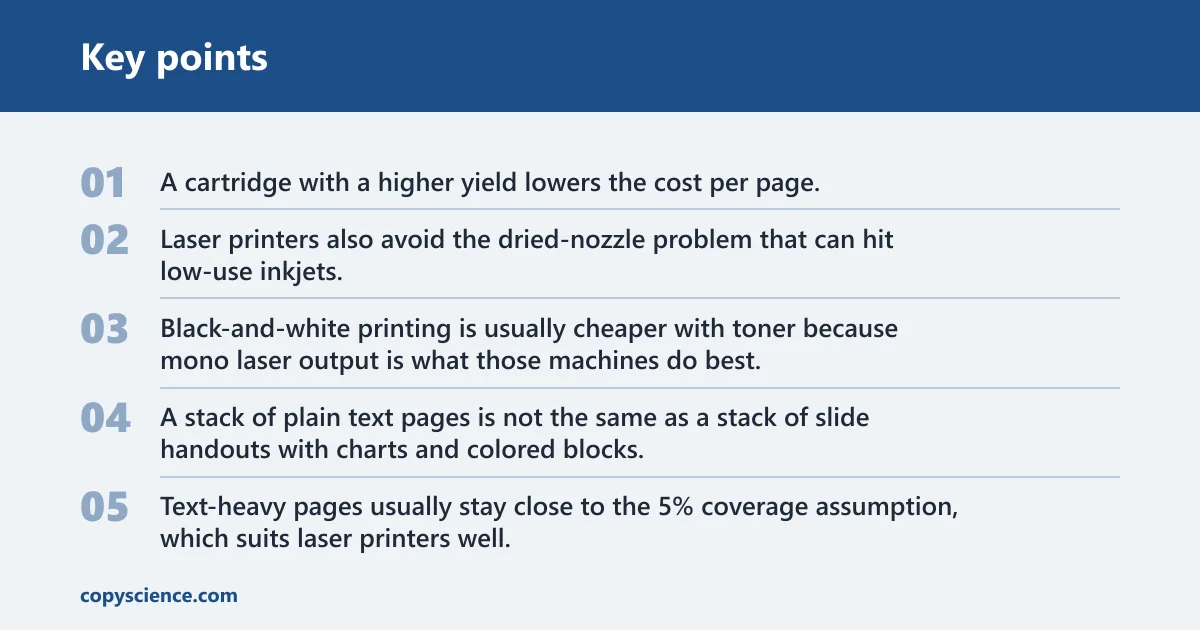
A cartridge with a higher yield lowers the cost per page. That matters because replacement frequency is where inkjets often get expensive: more swaps, more leftover ink, and more risk of waste from cleaning cycles after long idle periods.
Laser printers also avoid the dried-nozzle problem that can hit low-use inkjets. If a printer sits unused for weeks, an inkjet may waste ink during cleaning or head maintenance before it prints cleanly again. That hidden waste is small on one job and annoying over a year.
Black-and-white versus color cost
Black-and-white printing is usually cheaper with toner because mono laser output is what those machines do best. Color changes the equation. Color inkjets are often better for occasional photo printing and mixed graphics, while color laser printing can raise consumable costs enough to narrow or erase the advantage.
That is why page mix matters. A stack of plain text pages is not the same as a stack of slide handouts with charts and colored blocks.
Why text-heavy pages favor laser
Text-heavy pages usually stay close to the 5% coverage assumption, which suits laser printers well. HP describes laser printers as speed-focused devices, and that fits the broader use case: repeated document printing, not photo-first output.
For students and home office users who print assignments, forms, or invoices, toner often becomes the lower-cost path once the page count rises enough to repay the higher printer price.
When does toner pay off?
Toner usually pays off once monthly volume gets into the middle range, especially if most pages are plain text. At low volume, the cheaper printer price of an inkjet can outweigh its higher running cost. At high volume, the per-page savings of toner typically dominate the total.
Low-volume home use
At around 25 pages a month, printer price matters more than consumable efficiency. That makes inkjets the more affordable option for many infrequent home users, especially if you print color only once in a while.
Low-use households also need to account for dried ink and cleaning cycles. Those costs do not always show up on the spec sheet, but they do show up in the cartridge bill.
Medium-volume home office use
At around 100 pages a month, the balance starts to change. A toner printer can repay its higher upfront cost over a 36-month horizon because the per-page cost is lower, even before you factor in waste from inkjet maintenance.
This is the range where many people stop thinking in terms of one cartridge and start thinking in terms of total cost of ownership.
High-volume document printing
At around 300 pages a month, toner usually wins clearly. The more pages you print, the more the lower per-page cost matters, and the less important the purchase price becomes in the total.
That is the point where a laser printer’s higher entry cost stops being the main issue. Consumables drive the result.
Choose Printer ink if… / Choose toner cost if…
Choose Printer ink if you print only a few pages a month, want lower upfront cost, or need better-looking color and photo output. Choose toner cost if you print text often, expect a medium-to-high monthly page count, or want lower long-term cost over a 3-year horizon.
- Choose Printer ink if… you print about 25 pages a month or less, your jobs are occasional, and photo-friendly color matters more than per-page economy.
- Choose Printer ink if… you are buying for a dorm, small household, or light-use home setup where the printer may sit idle for long stretches.
- Choose toner cost if… you print around 100 pages a month or more, mostly text, and want the lower running cost to offset the higher printer price.
- Choose toner cost if… you print labels, forms, school packets, or home office documents often enough that cartridge yield matters every month.
Picture a student who prints two assignments a month and a few color charts before exams. Printer ink is the cleaner fit there. Picture a home office that prints invoices, shipping labels, and weekly reports. The laser printer becomes cheaper once the page count keeps climbing.
Frequently asked questions
Is toner cheaper than ink in the long run?
Usually yes, but only after enough pages. Toner tends to win when monthly volume is moderate or high because the per-page cost is lower and the cartridge yield is higher. At very low volume, the cheaper inkjet printer can still come out ahead over three years.
Which lasts longer, ink cartridges or toner cartridges?
Toner cartridges usually last longer because they hold enough powder for a higher page yield. Ink cartridges are liquid-based and generally need more frequent replacement, especially when color is used often or the printer cleans itself after sitting idle.
Why is toner more expensive upfront but sometimes cheaper per page?
Toner printers often cost more to buy because the hardware is built for laser printing and faster document output. The cartridge itself usually lasts for more pages, so the cost spreads over a larger number of sheets and the per-page figure drops.
What is the cost per page for inkjet and laser printers?
There is no single universal number, because printer model, cartridge yield, and page coverage all change the math. A 5% coverage assumption is the usual starting point for text-heavy documents, and that is where laser printers often show the lower cost per page.
Which printer type is best for infrequent home printing?
An inkjet printer is usually the better fit for infrequent home printing because the lower upfront price matters more than cartridge efficiency at low volume. If you print only a few pages at a time, a laser printer can spend too long sitting idle before its lower running cost pays off.