What Is the Difference Between Printer Ink and Toner?

Ink is a liquid dye or pigment moved through tiny nozzles onto paper. Toner is a dry powder that a laser printer bonds to the page with heat. That is why inkjet printers fit photos and light home use, while laser printers suit heavier text and graphics output. Pick the wrong one and you can end up paying more per page, waiting for pages to dry, or buying a printer that does not match your print volume. This guide explains what each cartridge contains, how each system prints, what fails, and which everyday home tasks suit each one.
How inkjet and laser printers work
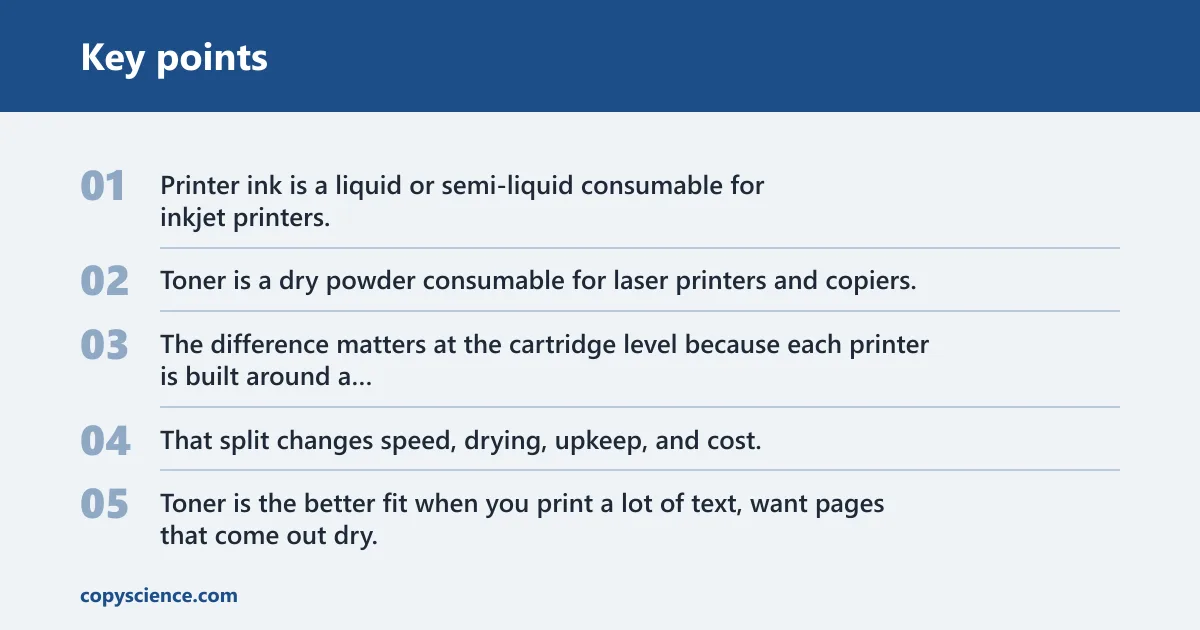
Printer ink is a liquid or semi-liquid consumable for inkjet printers. Toner is a dry powder consumable for laser printers and copiers. The difference matters at the cartridge level because each printer is built around a specific print path: one sprays droplets through nozzles, the other moves powder with a drum and fixes it with heat.
That split changes speed, drying, upkeep, and cost. Ink gives smooth color and photo output. Toner is the better fit when you print a lot of text, want pages that come out dry, or need lower cost per page over time.
Ink vs toner: how each prints
An inkjet printer uses microscopic nozzles to spray tiny drops of ink onto the page. The ink then dries by soaking into the paper fibers, evaporation, or both. That is why inkjets can produce smooth gradients and photo detail, and also why an idle printer can end up with dried ink in the print head and nozzles.
A laser printer uses electrostatic drum technology. The drum attracts toner where the image belongs, and a fuser or heating roller bonds the toner to the paper with heat. Laser printer output is often dry right away and less likely to smear, especially on plain paper.
Why the print path matters
The print path is not a side detail. It controls how fast a page comes out, when you can stack it, and what tends to fail first when a printer sits unused. Inkjet systems move liquid through small openings; laser systems use dry powder, a drum, and a hot fuser.
If a home printer sits idle for about three weeks, it may need an inkjet cleaning cycle before an urgent one-page print job. An inkjet may need a cleaning cycle because the nozzles dried a little. A laser printer usually starts cleaner because toner does not dry out in the same way.
What is printer ink?
Printer ink is a liquid or semi-liquid formula used in inkjet printers. It usually contains dyes or pigments plus a solvent and additives that control flow, drying, and paper behavior. Some inkjet printers use separate black, cyan, magenta, and yellow cartridges.
Ink dries by soaking into the page or by evaporation. That makes it flexible for plain paper, glossy photo paper, and mixed home use, but it also means storage and idle time matter. If the printer sits unused, ink can dry in the print head and nozzles, which affects reliability and may require cleaning.
Dye-based ink and pigment-based ink
Dye-based ink is commonly reported to produce very smooth color transitions and vivid photos. Pigment-based ink uses tiny solid particles suspended in the liquid, which usually improves water resistance and fade resistance on many papers.
That difference matters. A family photo printed with dye ink may look very smooth, while a label or document printed with pigment ink may hold up better to moisture and handling. Printer settings and paper type still matter, but the ink chemistry is part of the result.
Common ink failure points
The weak spot in many inkjet printers is the print head and its nozzles. If ink dries there, you can get missing lines, faded sections, or banding across the page. Some printers recover with a cleaning cycle; others waste a noticeable amount of ink doing repeated cleanings.
Leakage and handling also matter. Ink cartridges need to stay sealed and oriented properly, and dried residue around the nozzles can affect print quality even before the cartridge is fully empty. For low-volume home users, that is often the hidden cost of choosing inkjet.
What is toner?
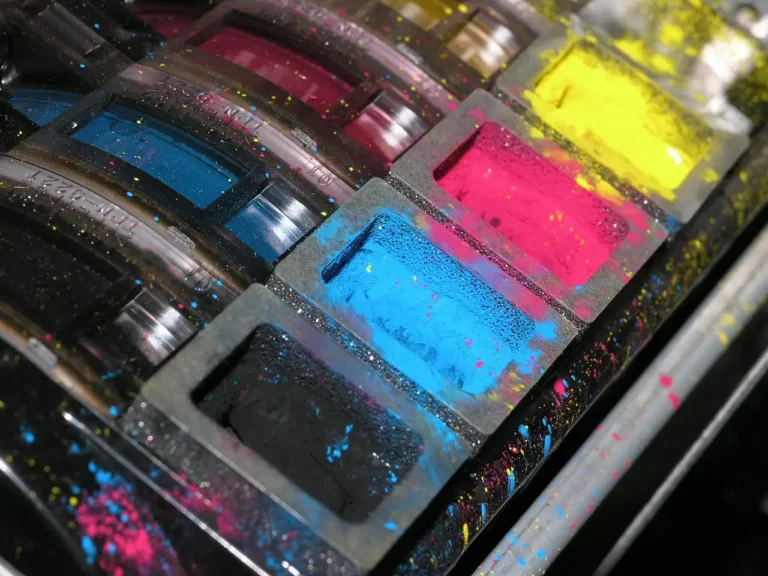
Toner is a fine powder used by laser printers and photocopiers. It is commonly made from polyester plastic, carbon, and coloring agents. The printer places that powder onto a charged drum, then uses heat from the fuser to bond it to the page.
Because the toner is fused rather than air-dried, the page comes out dry right away and is usually more resistant to smudging. Toner prints are also more resistant to water damage and smudging than typical ink prints, which matters for shipping labels, forms, and pages that get handled often.
Laser printer parts that matter
The drum and the fuser do the heavy lifting. The drum builds the image, and the fuser or heating roller melts the toner into the paper. That is why laser printers are often faster for text-heavy jobs and can keep pace better when several people share one printer at home.
Upfront printer cost is often higher for laser models, but long-term cost per page can be lower. A common example is a toner cartridge that prints around 5,000 pages, while a high-yield toner cartridge can produce more than 10,000 pages. By contrast, an ink cartridge may only print 200 sheets in one example.
Why toner is usually lower maintenance
Toner does not dry out the way liquid ink can. That reduces one major failure mode. You still need to replace cartridges and may eventually service the drum or fuser, but routine storage is easier because the consumable is dry powder rather than a fluid that can evaporate or clog nozzles.
That does not mean toner is perfect. Fine powder still needs careful handling, and some laser printers are large or cost more to buy. But for many home users who print text often, the maintenance profile is simpler than an inkjet’s.
Which printer suits your home printing?
The right choice depends on what you print, how often you print, and how long you are willing to wait for a page to dry. For homes that print photos or occasional color pages, inkjet often fits better. For homes that print text frequently, toner usually makes more sense.
School worksheets and bills
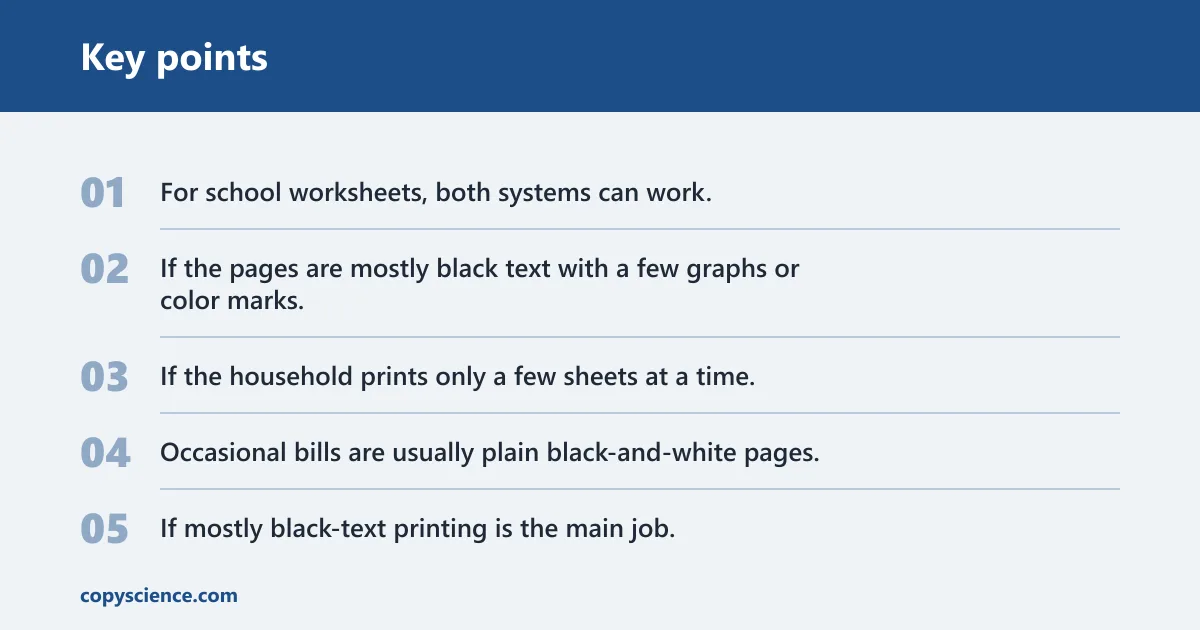
For school worksheets, both systems can work. If the pages are mostly black text with a few graphs or color marks, a laser printer often gives cleaner text and lower cost per page. If the household prints only a few sheets at a time, an inkjet can still be a sensible choice if the printer is already in use for photos.
Occasional bills are usually plain black-and-white pages. If mostly black-text printing is the main job, a monochrome laser printer is often worth a close look. It gives fast output and avoids paying for color supplies you rarely need.
Family photos and color pages
For family photos, inkjet usually wins because it can place tiny droplets with enough control to create smoother gradients and more natural color transitions. Glossy photo paper also pairs well with many inkjet systems.
A common first-timer mistake is buying a laser printer for photo printing because the box says “color.” Color laser printers can print color, but they are usually not the best fit for photo-focused home use. Toner is more durable on plain paper, while inkjet is usually stronger on image smoothness.
Shipping labels, high-volume text, and mixed-use home office
Shipping labels favor toner because the print is more smudge-resistant and dries instantly. High-volume text jobs also favor laser printers because they are faster in higher-volume use and often cost less per page over time.
For a mixed-use home office, the answer depends on volume. If you print mostly text, forms, and labels, laser is usually the better technology. If you print more color charts, school art sheets, or photos, inkjet can be the better fit even if cartridges need replacement more often.
Choose ink if… / Choose toner if…
Choose ink if you print photos, color graphics, or only a few pages at a time. Choose toner if you print text often, want faster output, or need lower cost per page. The printer type matters as much as the cartridge type, so match the consumable to the machine first.
- Choose ink if you want the best fit for photos and smooth color gradients.
- Choose ink if your print volume is low and you do not mind occasional cleaning cycles.
- Choose toner if you print school papers, invoices, shipping labels, or other text-heavy pages often.
- Choose toner if you want pages that come out dry and resist smearing.
- Choose toner if you expect higher long-term page counts and fewer cartridge swaps.
- Choose a monochrome laser printer if nearly everything you print is black text.
Ink toner decision matrix
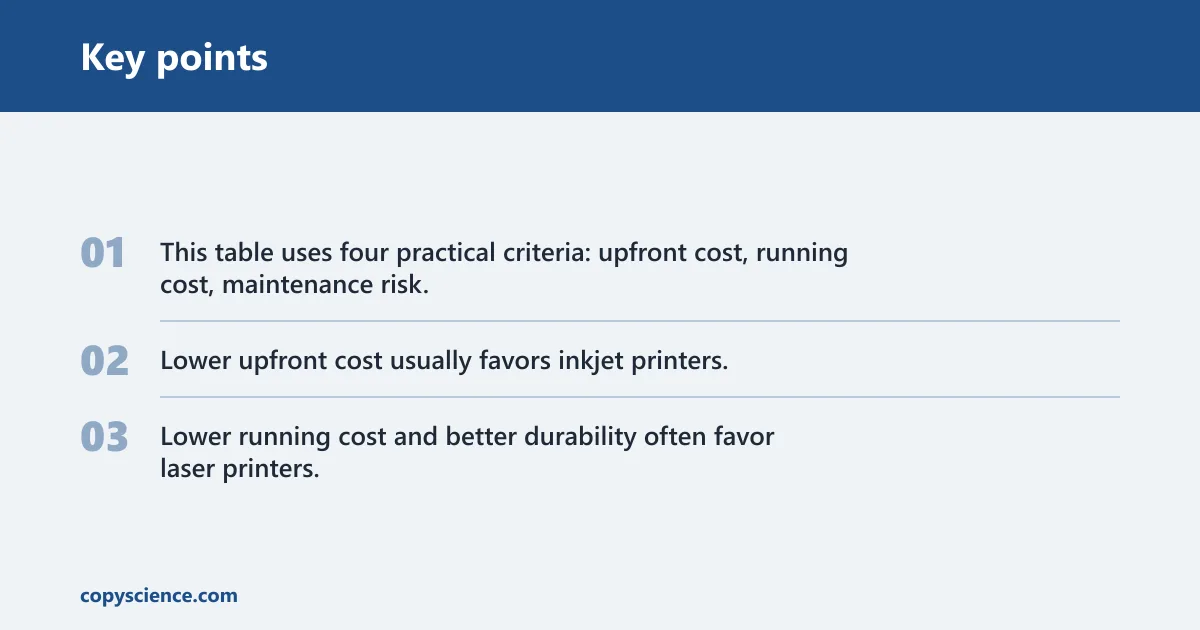
This table uses four practical criteria: upfront cost, running cost, maintenance risk, and print durability. Lower upfront cost usually favors inkjet printers. Lower running cost and better durability often favor laser printers, especially for text-heavy home use.
| Home printing scenario | Ink: upfront cost | Ink: running cost | Ink: maintenance risk | Ink: print durability | Toner: upfront cost | Toner: running cost | Toner: maintenance risk | Toner: print durability |
|---|---|---|---|---|---|---|---|---|
| School worksheets | Lower | Higher if volume rises | Moderate if unused often | Good on plain paper; varies by formula | Higher | Lower for steady text printing | Low to moderate | Strong for handling and smudging |
| Family photos | Lower | Higher for color-heavy pages | Moderate to high if idle | Very good with photo paper; best with dye-based ink for smooth color | Higher | Usually not cost-effective for photo-heavy use | Low | Good, but usually not the best photo look |
| Occasional bills | Lower | Can be wasteful at very low use | Higher if the printer sits unused | Adequate for office-style pages | Higher | Often efficient if you print regularly | Low | Very good for handling and filing |
| Shipping labels | Lower | Higher if labels are frequent | Moderate | Can smear if not fully dry | Higher | Lower over time | Low | Excellent for smudge resistance |
| High-volume text | Lower | Usually higher page cost | Higher under heavy use without upkeep | Good, but drying can limit handling | Higher | Lower, especially with high-yield toner | Low | Strong and immediate |
| Mixed-use home office | Lower | Depends on color use and volume | Moderate | Good for color pages and photos | Higher | Lower for text-heavy workflows | Low | Very good for text, forms, and labels |
Frequently asked questions
What is the difference between printer ink and toner?
Printer ink is a liquid or semi-liquid consumable used in inkjet printers, while toner is a dry powder used in laser printers and copiers. Ink is sprayed through microscopic nozzles; toner is fused to paper with heat. That difference shapes cost, speed, dry time, and durability.
Is toner the same as ink in a printer?
No. Toner and ink are different materials built for different printer technologies. Ink belongs in inkjet systems, where it is sprayed onto paper. Toner belongs in laser systems, where the printer uses a drum and fuser to bond powder to the page with heat.
What is the difference between toner and ink cartridge?
An ink cartridge holds liquid ink for an inkjet printer. A toner cartridge holds dry powder for a laser printer. They are not interchangeable, and they do not install in the same type of machine. The cartridge matches the printer’s print path and internal hardware.
What happens if you use ink instead of toner in a laser printer?
You should not do it. A laser printer is designed for dry powder, a drum, and heat fusion, not liquid ink and nozzles. If the wrong consumable were forced into a machine, the printer would not function correctly and could be damaged. The consumable and printer type must match.
Do printers need ink and toner?
Most printers need one or the other, not both. Inkjet printers need ink cartridges. Laser printers need toner cartridges. Some all-in-one devices may print, scan, and copy, but their print engine is still one technology or the other, so the consumable type remains specific to that machine.
Is printer ink and toner the same thing?
No. Printer ink and toner are different consumables for different systems. Ink is liquid and dries after it lands on the page. Toner is powder that is fixed to the paper with heat. The differences show up in page yield, maintenance, and print durability.