Inkjet vs Laser Printer Total Cost: What Pays Off

Inkjet usually costs less to buy. Laser often costs less to own once you print around 100 pages a month or more, depending on the model and consumables; below that, a lower-cost inkjet may come out ahead over three years. If you ignore running costs, cartridges or toner can end up costing more than the printer. This guide compares purchase price, 3-year ink and toner costs, and a simple break-even point for home and small-office use.
| Factor | Inkjet | laser printer total cost | Winner |
|---|---|---|---|
| Upfront price | Usually lower | Usually higher | Inkjet |
| 3-year cost at low volume | Lower in this worksheet | Higher in this worksheet | Inkjet |
| 3-year cost at medium volume | About equal to slightly lower | About equal to slightly higher | Inkjet |
| 3-year cost at high volume | Higher in this worksheet | Lower in this worksheet | laser printer total cost |
| Color-heavy printing | Stronger for photos and mixed color | Better for office color pages at volume | Tie |
| Home-office productivity features | Varies by model | Often stronger on speed and paper handling | laser printer total cost |
Upfront price vs long-term ownership
Inkjet usually wins on sticker price. Laser usually wins when monthly print volume is high enough to spread its higher purchase price over more pages. The cleanest comparison separates upfront cost, consumables, and maintenance across three years. That keeps low-use homes from paying for speed they will not use.
What usually costs less upfront
Inkjet printers usually cost less to buy, including cartridge-based models for home and home-office use. Laser printers usually cost more at checkout, especially if you want color printing or higher paper capacity. That gap matters less once consumables become the main expense.
What usually costs less to own
Laser usually has the edge once print volume rises, because toner often lasts longer than ink cartridges and the per-page cost drops as pages add up. But that edge is not automatic. A low-volume buyer can still spend less with inkjet over three years, especially if color pages are only occasional.
Printer cost worksheet
This worksheet uses simple planning assumptions, so the break point is illustrative rather than evidence-based. It compares a cartridge inkjet against a laser printer over 3 years, then shows why an ink tank model changes the picture. The assumptions are explicit, so the totals are easy to check.
| 3-year scenario | Pages per month | Inkjet assumption | laser printer total cost assumption | Inkjet total | laser total | Lower total |
|---|---|---|---|---|---|---|
| Low volume | 25 | $100 printer + 8¢ per page + $30 maintenance | $250 printer + 4¢ per page + $30 maintenance | $202 | $316 | Inkjet |
| Medium volume | 100 | $100 printer + 8¢ per page + $40 maintenance | $250 printer + 4¢ per page + $40 maintenance | $428 | $434 | Inkjet |
| High volume | 300 | $100 printer + 8¢ per page + $60 maintenance | $250 printer + 4¢ per page + $60 maintenance | $1,024 | $742 | laser printer total cost |
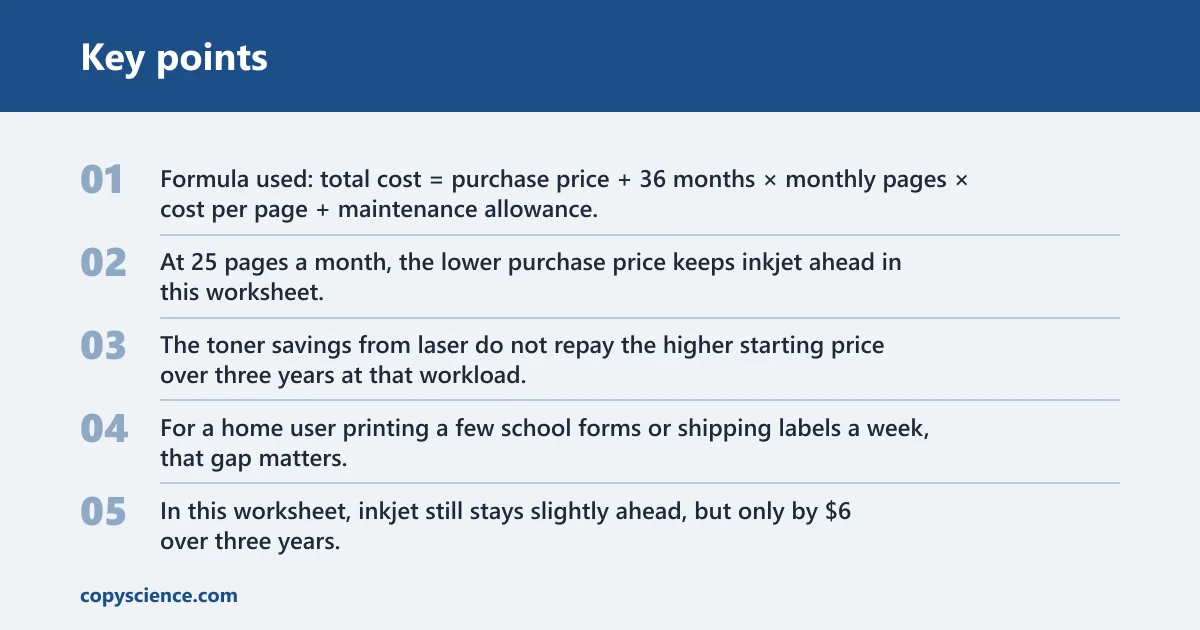
Formula used: total cost = purchase price + 36 months × monthly pages × cost per page + maintenance allowance. Electricity is left out because it is a secondary cost in this model and usually too small to move the decision unless the machines differ a lot in duty cycle.
3-year low-volume scenario
At 25 pages a month, the lower purchase price keeps inkjet ahead in this worksheet. The toner savings from laser do not repay the higher starting price over three years at that workload. For a home user printing a few school forms or shipping labels a week, that gap matters.
3-year medium-volume scenario
At 100 pages a month, the math tightens. In this worksheet, inkjet still stays slightly ahead, but only by $6 over three years. That is close enough that a buyer should weigh features, color use, and service risk, not only purchase price.
3-year high-volume scenario
At 300 pages a month, laser pulls ahead by a wide margin. The higher upfront price gets absorbed by the lower per-page running cost. This is the point where the cheapest printer to buy stops being the cheapest printer to own.
Break-even note
Using the assumptions above, laser appears to overtake inkjet at around 100 pages a month over three years, but that crossover can shift widely by model and consumable costs. If your monthly volume is below that level, cartridge inkjet can still be the lower-cost choice.
How purchase price changes the math
Upfront price matters most when your page count is low and your printer may sit idle for long stretches. Cartridge inkjets usually have the lowest buy-in, tank inkjets sit in the middle, and laser printers often cost the most at checkout. That is why the “cheap” printer is not always the cheap one to own.
Cartridge inkjet startup cost
Cartridge inkjet is the lowest-cost entry point for most home buyers. It also fits mixed household use better because it handles color and photo printing well. The trade-off is ongoing cartridge expense, which can rise quickly if you print in bursts or leave the printer unused for long periods.
Tank inkjet startup cost
Ink tank printers usually cost more upfront than cartridge models, but they can change the value equation sharply. That kind of model can close the gap with laser for people who print often but still want strong color output.
Laser printer startup cost
Laser printers usually start higher because the hardware is built for higher duty cycles and toner-based output. For buyers comparing office use, that matters because it affects time, refill frequency, and workflow.
Which printer has lower cost per page long term?
Laser usually has the lower cost per page once volume rises enough to offset the higher purchase price. Cartridge inkjet can still win at low volume because the machine is cheaper to buy and the page count is too small for toner savings to catch up. The answer depends on yield, color mix, and how many pages you actually print.
Ink cartridge and toner yield assumptions
Per-page cost is driven by consumable yield, not by the printer body alone. A cartridge inkjet can look inexpensive at the shelf and expensive on the page. A laser printer can do the opposite, especially if you print the same document type month after month.
Why color changes the comparison
Color printing changes the math because color laser and color inkjet do not carry the same cost profile. Color inkjet is often better for photos and occasional graphics. Color laser can be better for office documents when volume is steady, but it is usually a different investment class than a simple mono laser.
When laser starts to pull ahead
In the worksheet above, laser starts to pull ahead a little above 100 pages a month. That is a useful planning line, not a universal rule. If your cartridges are expensive, your pages are dense with color, or your printing is heavier than expected, the break-even can arrive sooner.
Do occasional users save with inkjet?
Yes, occasional users usually save with inkjet because low volume does not give laser enough room to earn back its higher upfront cost. The key exception is a very cheap laser model paired with steady black-only printing. For most low-use homes, a cartridge inkjet or a tank inkjet is the better financial fit.
Why low volume changes the answer
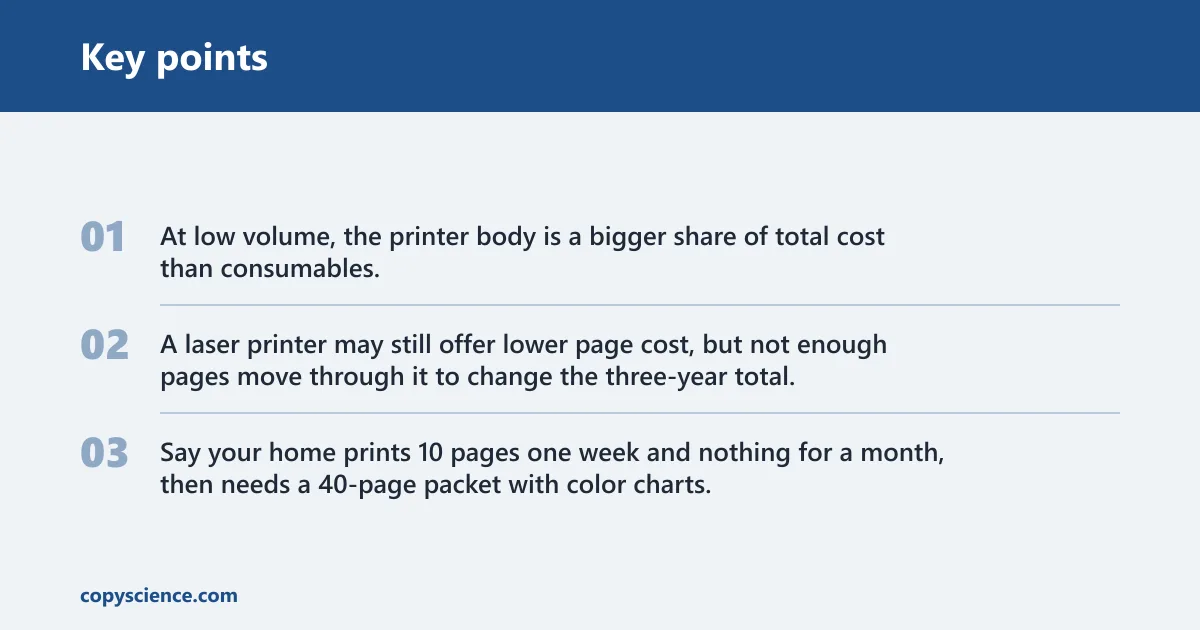
At low volume, the printer body is a bigger share of total cost than consumables. That favors the cheaper machine. A laser printer may still offer lower page cost, but not enough pages move through it to change the three-year total.
Where Instant Ink fits
Instant Ink can improve cost predictability on eligible inkjets because the subscription shifts some of the uncertainty from replacement cartridges to a monthly plan. This matters most when you want a steadier monthly bill rather than surprise cartridge purchases.
Why dry-out risk matters for infrequent use
Infrequent printing raises the chance that cartridge inkjet owners will deal with dried nozzles, cleaning cycles, or wasted ink. That is an ownership risk, not a certainty. It is one reason occasional users should compare not only price per page, but also how often the printer will sit unused.
Say your home prints 10 pages one week and nothing for a month, then needs a 40-page packet with color charts. A cartridge inkjet may still be cheaper overall, but the extra maintenance and possible cleaning cycles can eat into the advantage if the printer sits idle between jobs.
How color printing affects total cost
Color changes the comparison because photo jobs, charts, and school handouts do not cost the same on every printer type. Inkjet usually makes more sense for photo-heavy or mixed color work. Laser usually makes more sense for repetitive office color pages where the main goal is fast, durable text and graphics.
Color inkjet vs color laser
Color inkjet is usually the better match for home photo printing and mixed documents. Color laser can look appealing for office reports, but color toner hardware often raises the purchase price enough that low-volume buyers do not recover the premium. The split matters because color is one of the fastest ways to distort a black-and-white cost comparison.
Photo and graphics use cases
If your pages include photos, artwork, or presentations with saturated graphics, inkjet keeps the value argument stronger. Laser is better suited to text-heavy color pages and internal business documents. That is why “color” alone is not enough; the page type matters.
When mono laser is the better value
Mono laser is often the strongest value when the work is mostly black text and the volume is steady. It avoids the color premium that can make color laser less attractive. For invoices, shipping labels, and long text documents, mono laser can be the most economical route.
What features matter for home office buyers?
For home office buyers, features matter because they change labor cost, not only printer cost. Pages per minute is a useful workload proxy, but it should sit alongside duplex printing, sheet capacity, and scan features. Faster output and fewer refills save time when the printer is part of a daily routine.
-
Match speed to workload. If you print in bursts, compare pages per minute to your actual queue size. Those speeds are useful when a small office needs to move jobs quickly.
-
Check paper handling. A larger input tray reduces refill frequency, which matters more as volume rises. For a busy shared desk, that difference can save interruptions.
-
Look for duplex and scan features. Two-sided printing reduces paper use, and two-sided scanning reduces manual handling. Those features matter when documents flow through the device every day.
-
Use efficiency as a secondary filter. ENERGY STAR can be useful, but it is not the main cost driver in this comparison. If two printers are close on purchase price and consumables, then efficiency may help. If one model is far cheaper per page, that difference usually outweighs the power label.
Choose Inkjet if… / Choose laser printer total cost if…
Choose inkjet if your monthly volume stays low, you need better color or photo output, or you want the lowest upfront cost. Choose laser if you print often, mostly in black text, or want the lower three-year cost once volume crosses the break-even point. Tank inkjet sits in the middle when you want lower running cost without moving to laser.
Choose Inkjet if…
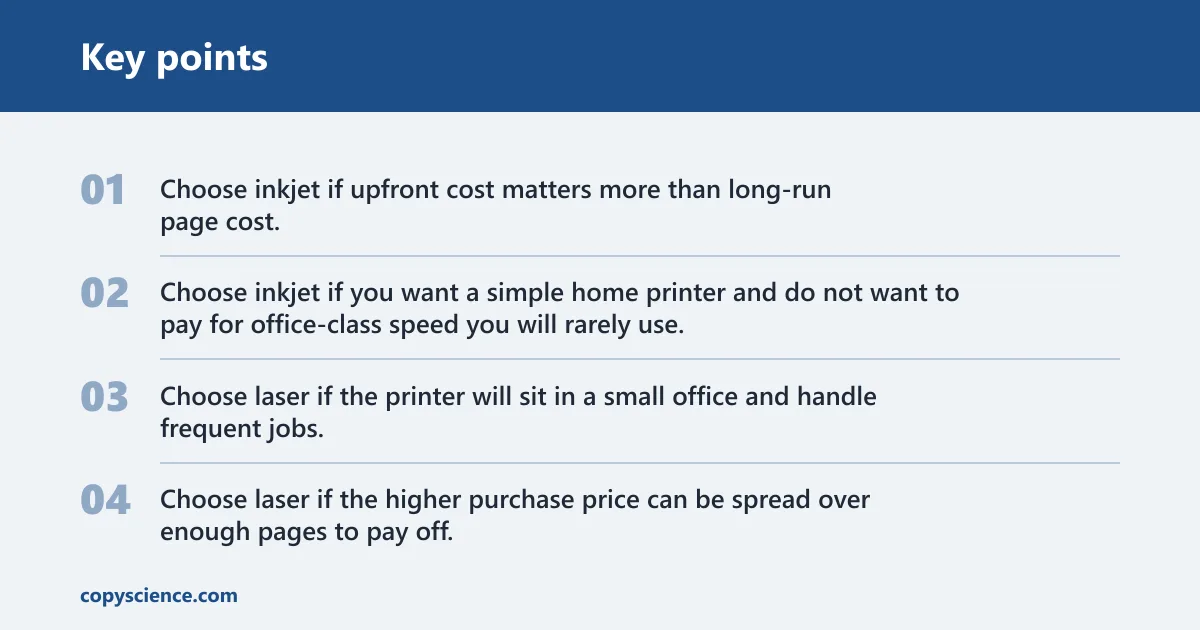
Choose inkjet if you print fewer than about 100 pages a month under the worksheet assumptions, especially if you print color or photos only occasionally. Choose inkjet if upfront cost matters more than long-run page cost. Choose inkjet if you want a simple home printer and do not want to pay for office-class speed you will rarely use.
Choose laser printer total cost if…
Choose laser if you print a lot of text pages, want lower cost per page at higher volume, or need quicker turnaround for shared work. Choose laser if the printer will sit in a small office and handle frequent jobs. Choose laser if the higher purchase price can be spread over enough pages to pay off.
Frequently asked questions
Is an inkjet or laser printer cheaper overall?
Inkjet is usually cheaper overall for low-volume buyers, while laser often becomes cheaper over three years once monthly printing rises. The answer depends on purchase price, consumables, and how often you print. For a casual home user, inkjet usually wins. For a busier office, laser usually wins.
How much do inkjet and laser printers cost to buy?
Inkjet usually costs less at checkout, and laser usually costs more. The exact spread varies by model, color support, duplexing, and paper capacity. If you are comparing a basic home printer against an office-focused model, expect the office machine to cost more upfront.
Do laser printers save money if I print only occasionally?
Usually not. If you print only occasionally, the higher upfront price of laser can take years to recover. A low-cost inkjet often remains the better three-year choice, especially for mixed home use. If you print very little black text, the savings from toner may never catch up.
Are ink tank printers cheaper than laser printers over time?
They can be, especially at moderate volume. Ink tank printers lower the running cost enough to compete with laser while keeping strong color output. They are the kind of model that can shift the comparison away from cartridge inkjets.
What hidden costs matter besides the printer price?
Consumables matter most, but maintenance, replacement parts, downtime risk, and electricity can also affect ownership cost. These are usually secondary to ink or toner spend, yet they matter more when printers sit unused or handle heavier jobs. A cheap printer can become expensive if it needs frequent cleanup or service.
Which printer is better for home office use?
It depends on workload. If you print frequently, scan often, or want features like duplexing and larger sheet capacity, laser or an office-grade inkjet can make more sense. If your home office prints mostly color and only a modest number of pages, a cartridge or tank inkjet can still be the better value.
How does color printing change the total cost comparison?
Color usually pushes the comparison toward inkjet for photos and toward laser for steady office graphics. Color laser can raise the entry price enough that low-volume buyers do not recover it. If your printing is mostly text with only occasional color, mono laser often gives the cleanest value case.