Is Ink or Toner Better for Home Printing Needs?

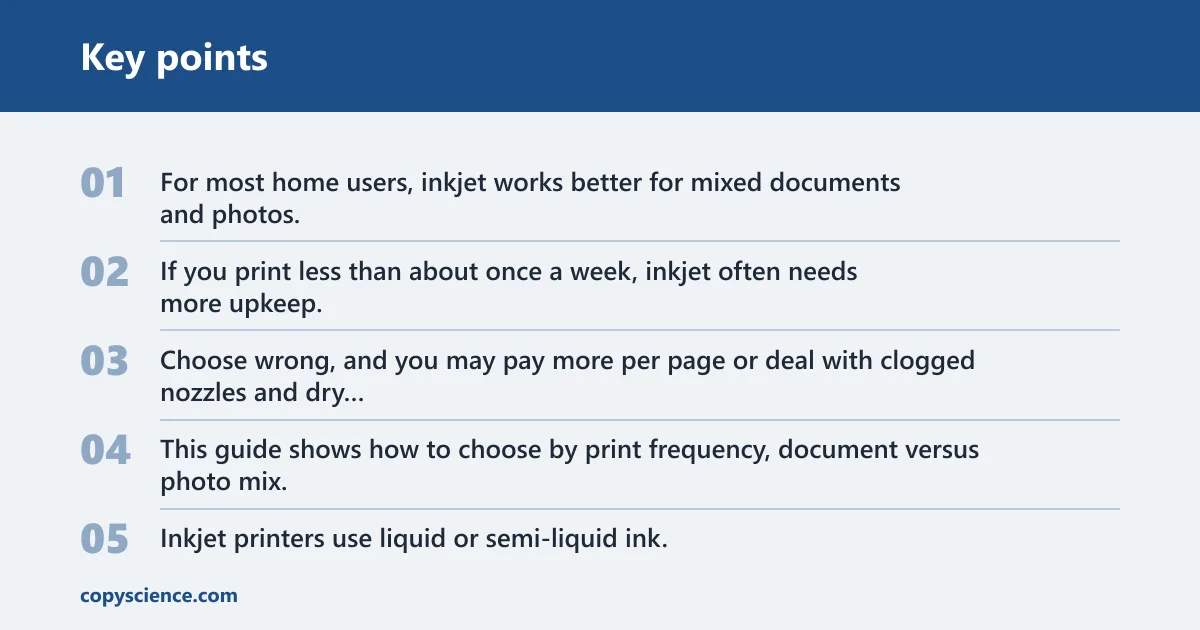
For most home users, inkjet works better for mixed documents and photos, while laser works better for text-heavy pages and lower cost per page. If you print less than about once a week, inkjet often needs more upkeep. Choose wrong, and you may pay more per page or deal with clogged nozzles and dry cartridges. This guide shows how to choose by print frequency, document versus photo mix, cost per page, and maintenance tolerance.
Inkjet vs laser at a glance
Ink vs toner at a glance
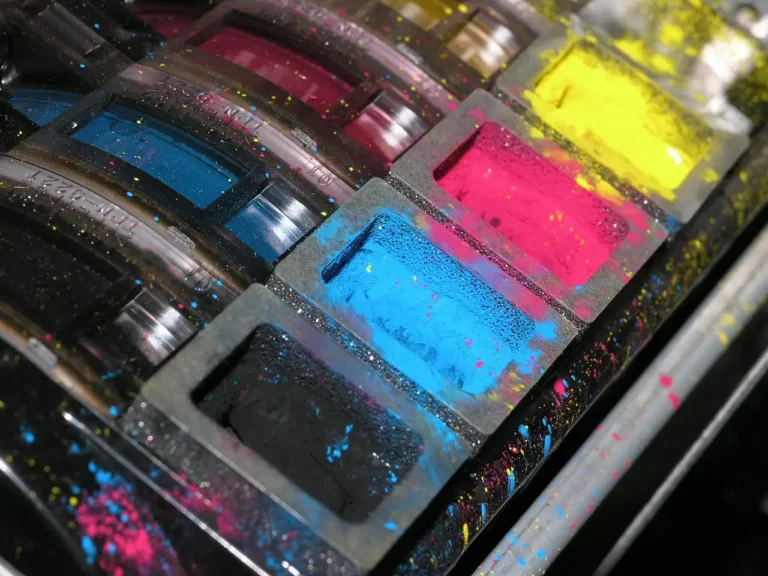
Inkjet printers use liquid or semi-liquid ink. Laser printers use toner powder. That difference changes print quality, speed, supply cost, and how well the printer handles long gaps between jobs.
Inkjet printers are usually the better pick for color photos, graphics, and mixed household printing. They often cost less upfront, but ink cartridges can dry out or clog after idle periods, and some printers run cleaning cycles that waste ink.
Laser printers are usually better for sharp text and batch printing. They often print faster, usually measured in pages per minute, and they usually handle long gaps better because toner does not dry out the way liquid ink can.
| Criteria | Inkjet printer | Laser printer |
|---|---|---|
| Best for | Photos, color graphics, mixed home pages | Text-heavy documents, batch jobs, recurring paperwork |
| Supply type | Ink cartridge, liquid supply, standard or XL/high-yield | Toner cartridge, powder-based supply, standard or high-yield |
| Print quality strength | Photo vibrancy and color blending | Text sharpness and smudge resistance |
| Maintenance risk | Dried nozzles, clogged print heads, wasted cleaning cycles | Toner fusion issues are possible, but idle-time drying is less common |
| Upfront printer cost | Often lower | Often higher |
| Typical home fit | Occasional color, school projects, family photos | Weekly documents, home office pages, larger text runs |
Which is cheaper for occasional home printing?
For occasional home printing, the cheaper choice depends on whether you mean the printer price or the total cost over time. Inkjet models often cost less to buy, but infrequent use can raise the real cost through dried ink, maintenance cycles, and shorter cartridge life. Laser can cost more upfront, yet may be cheaper per page if you print text regularly.
How print volume changes cost per page
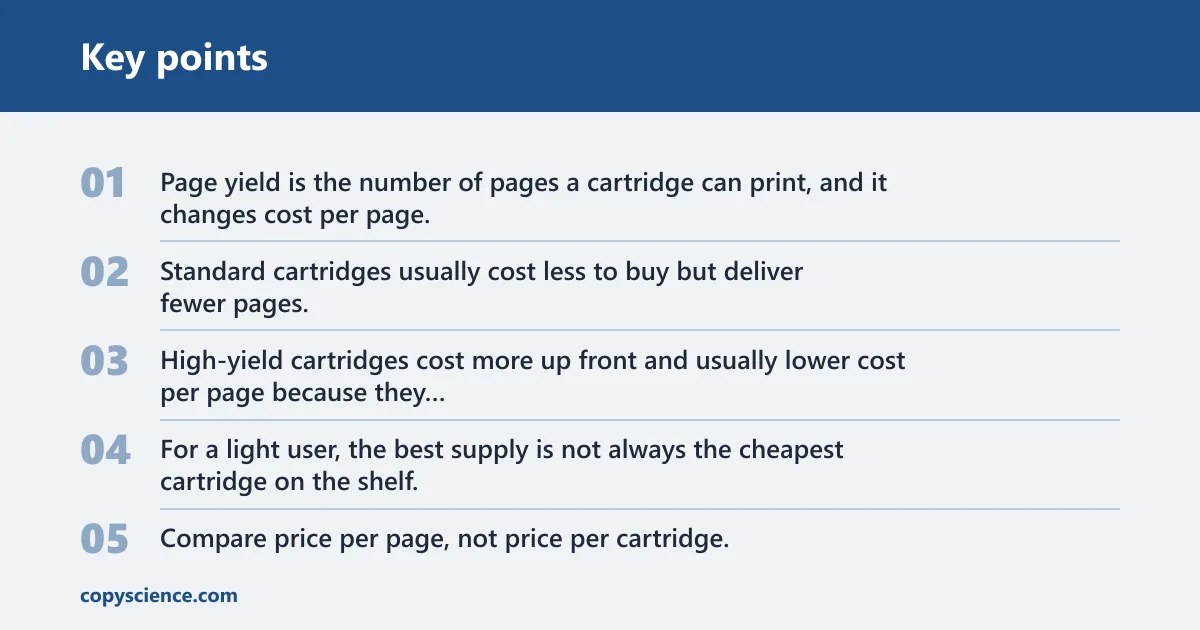
Page yield is the number of pages a cartridge can print, and it changes cost per page. Standard cartridges usually cost less to buy but deliver fewer pages. High-yield cartridges cost more up front and usually lower cost per page because they print more before replacement.
For a light user, the best supply is not always the cheapest cartridge on the shelf. Compare price per page, not price per cartridge. Two cartridges can look similar in price and perform very differently once page yield is included.
Why low use can raise inkjet maintenance cost
Low use can affect inkjet more than laser because liquid ink can dry in nozzles and print heads. That can trigger cleaning cycles, which use ink before a page is even printed. If you print only a few pages a month, those hidden maintenance pages can matter as much as the pages you meant to print.
Suppose you print a homework sheet and a shipping label every two or three weeks. An inkjet may sit long enough for the black channel to need cleaning before the first page comes out clean. The printer still works, but some of your ink goes into recovery instead of output.
When toner makes more sense for light but steady document printing
Toner makes more sense when your light printing is steady, especially if you print every week or every other week and most pages are text. A laser printer can sit longer without drying out, and toner cartridges often last longer between replacements than ink cartridges of similar class.
That does not make laser the universal answer. If your home printing includes school posters, color handouts, or photo pages, inkjet still wins on color handling even if toner is easier to live with.
What prints better for home photos?
For home photos, ink is usually better than toner. Inkjet printers handle color gradients, skin tones, and fine color variation better, so they are the usual choice for photo prints and graphics-heavy pages. Laser printers can print color, but photo vibrancy and blending are usually weaker than a good inkjet’s output.
Text sharpness and smudge resistance
Laser printing has the edge for crisp text, especially on plain paper. Toner also tends to resist smudging better right off the page. That makes laser a strong option for homework, forms, invoices, and anything that should read cleanly after handling.
Ink can still produce sharp text, especially with pigment-based black ink, but output quality depends more on the printer model and paper. On glossy photo paper, inkjet usually has the advantage. On a stack of plain-paper handouts, laser often looks cleaner and dries faster.
Where each one fits best
Picture a household that prints a 4×6 vacation photo once a month and a few return labels each week. An inkjet fits that mix well if the printer is used often enough to keep the nozzles clear. A laser printer fits better if the same household cares more about neat text than color depth.
Does ink dry out if I do not print often?
Yes. Ink can dry out if you do not print often, and that is one of the main home-use problems with inkjet printers. Dried nozzles and clogged print heads can make the first page streaky or blank, and the printer may run cleaning cycles that waste ink before normal printing resumes.
What toner changes for low-use homes
Toner does not dry out like liquid ink, so it is usually a better match for homes that print only sometimes. That does not make toner maintenance-free. Laser printers can still have supply issues, and toner itself can be messy if a cartridge leaks, but long idle periods are usually less of a problem than with inkjet.
A common first-timer mistake is buying a cheap inkjet for rare printing and then assuming the low purchase price means low total cost. If the printer spends most of its life idle, the hidden cost may show up as clogged heads, wasted cleaning, and replacement cartridges sooner than expected.
Printer decision matrix
This matrix turns the choice into a home-use decision. Start with how often you print, then check whether your pages are mostly photos, mixed color, or text, and finally decide how much maintenance you are willing to accept.
| User segment | Recommended printer type | Why | Likely downside | Best supply choice |
|---|---|---|---|---|
| Occasional home user | Inkjet only if you print photos or color pages; otherwise laser | Ink gives better photo output, but laser handles rare text jobs with less idle-time risk | Inkjet may dry out between jobs; laser costs more at purchase | For inkjet, choose a high-yield cartridge if the printer is used regularly enough; for laser, choose standard toner if volume stays low |
| Student | Laser for mostly notes and essays; inkjet for frequent color graphics or photo projects | Students usually need sharp text, quick output, and fewer maintenance pauses | Laser color can be costly; inkjet can waste ink during cleaning if used infrequently | High-yield toner for text-heavy work; high-yield ink only if color pages are common |
| Home office | Laser | Frequent document printing rewards faster output and lower cost per page | Higher upfront printer price; photo quality is usually weaker than inkjet | High-yield toner, especially for steady weekly or monthly page counts |
Ink or toner checklist
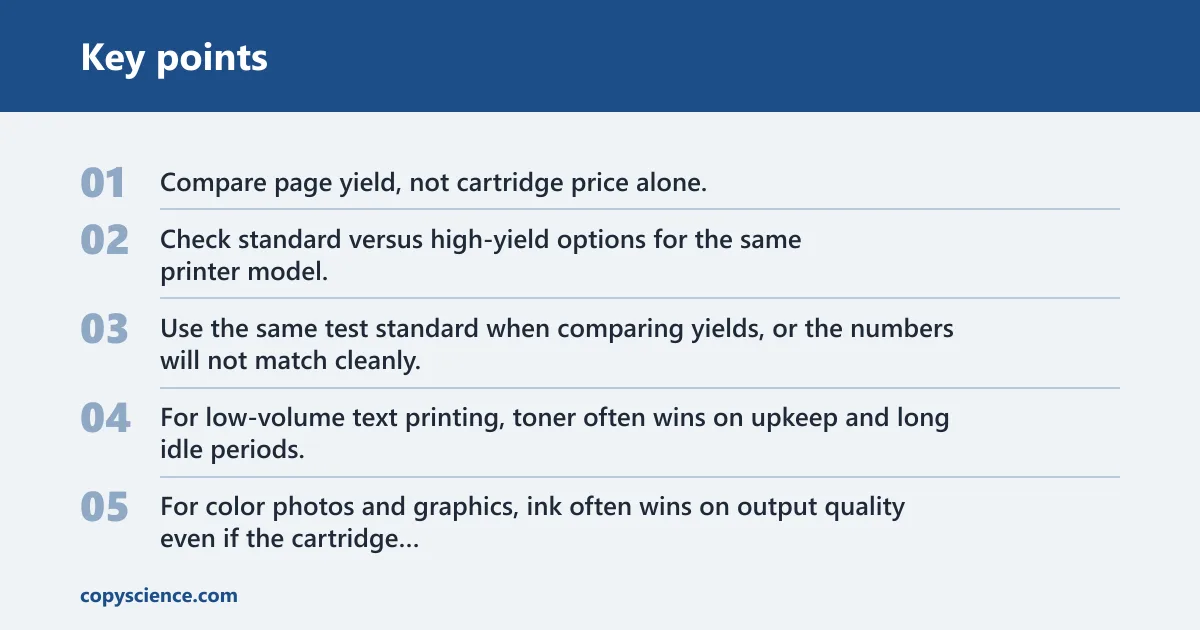
- Compare page yield, not cartridge price alone.
- Check standard versus high-yield options for the same printer model.
- Use the same test standard when comparing yields, or the numbers will not match cleanly.
- For low-volume text printing, toner often wins on upkeep and long idle periods.
- For color photos and graphics, ink often wins on output quality even if the cartridge costs more per page.
- Compare OEM and compatible supplies separately, because page yield and print quality can differ.
- Use OEM when printer compatibility and consistency matter most; consider compatible supplies only if the model match is exact and the seller backs the cartridge clearly.
Choose inkjet if… / Choose laser if…
Choose inkjet if you print photos, color graphics, school projects, or mixed home pages and you are comfortable printing often enough to prevent drying. Choose laser if you print mostly text, want faster batch output, and prefer less maintenance between jobs. The right answer depends on frequency, page type, and tolerance for upkeep.
Choose inkjet if your home prints lean toward color handouts, family photos, and occasional creative work. Choose laser if your pages are usually forms, essays, bills, and other plain-paper documents. If you print less than once a week, laser often reduces the risk of dried nozzles and wasted cleaning cycles.
Frequently asked questions
Is ink or toner better for home printing needs?
Ink is usually better for mixed color pages and photos, while toner is usually better for text-heavy printing and steady document runs. The better choice depends on print frequency, the kind of pages you make, and how much upkeep you are willing to handle between jobs.
Which is cheaper for occasional home printing, ink or toner?
Occasional printing often favors toner if you mostly print text, because toner avoids drying problems and usually lasts longer between replacements. Ink can look cheaper at checkout, but low use can raise the real cost through cleaning cycles and replaced cartridges.
Is an inkjet printer better than a laser printer for home use?
Inkjet is better for home use if your priority is photos, color graphics, or a lower upfront printer price. Laser is better if your home printing is mostly documents and you want faster output with less concern about ink drying out.
Do toner printers last longer if I only print sometimes?
Often, yes. Toner printers usually tolerate long gaps better because toner powder does not dry out the way liquid ink can. That does not make every laser printer perfect for low use, but it does reduce the maintenance risk that hits idle inkjets.
What prints better for home photos, ink or toner?
Ink usually prints better for home photos. It handles color transitions, vibrancy, and graphics more naturally than most laser printers. Laser can be fine for basic color charts or office graphics, but it is usually not the first choice for photo prints.
Does ink dry out if I don’t print often?
Yes. Ink can dry out in nozzles and print heads if the printer sits unused for long periods. That can lead to streaks, blank lines, or cleaning cycles that waste ink before normal printing starts again.
Do I need both ink and toner for one home printer?
No. A single printer usually uses either ink or toner, not both. Inkjet printers use ink cartridges, and laser printers use toner cartridges. If you want both kinds of output, you usually choose one printer type based on the main job, then live with its trade-offs.
What kind of printer should I buy for light home printing?
For light home printing, start with your page type. Pick laser if most pages are text and you print weekly or monthly. Pick inkjet if you need better photos or color pages and can print often enough to reduce drying and clogging risk.
Supply notes for buyers
Once you choose a printer type, supply details matter. 1ink says it ships orders within 24 hours on weekdays, offers free shipping on orders $65+ in the contiguous U.S., gives a 6-month warranty on cartridges, and says its cartridges are compatible with printers and guaranteed to work. 123inkjets offers free U.S. shipping over $55, says most orders ship the same day, and claims savings of up to 75% off ink and toner.
INKandINK offers free shipping on orders over $95. LD Products ships free on orders over $50 to the contiguous U.S. and says orders placed before 4pm usually ship the same day. Ink Technologies offers free shipping on orders over $50 and says orders placed by 3:30pm ET usually ship same day. Those shipping claims do not change the printer choice itself, but they can matter once you know whether you need ink or toner.