Do All Printers Require a Subscription?

Most printers do not require a subscription. Buying ink or toner as needed is often the lowest-cost path if you print rarely or only a few pages each month. Choose poorly, and you may pay for pages you never print, or pay too much per page. This guide compares subscription plans with pay-as-you-go ink for light, moderate, and heavy home printing.
When printers make accounts or plans necessary
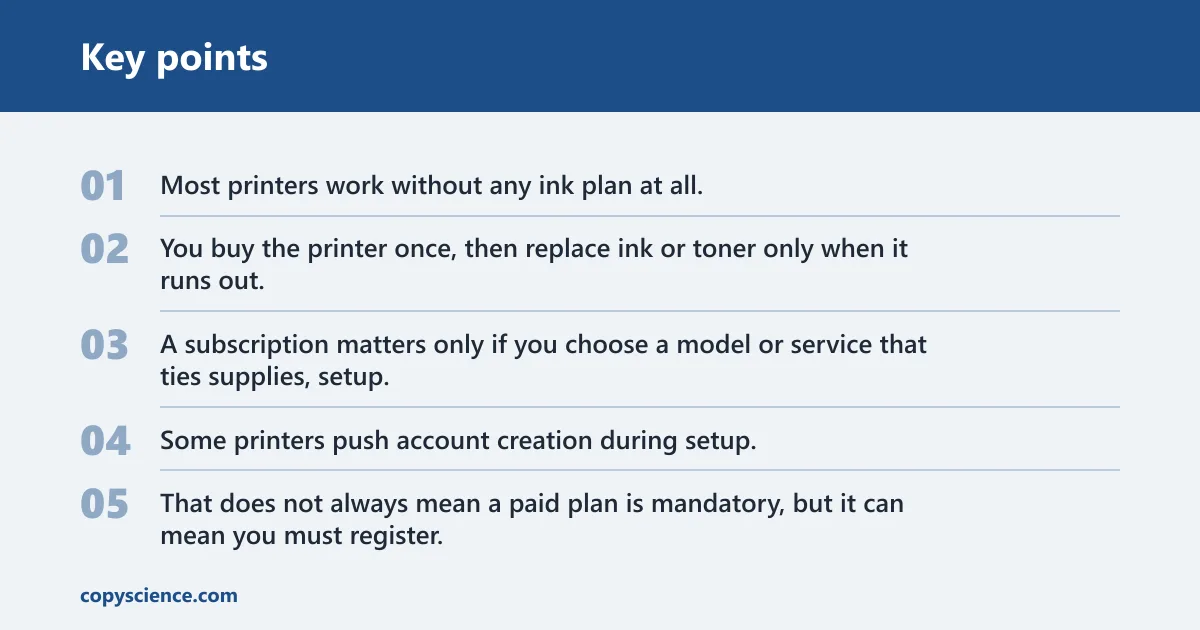
Most printers work without any ink plan at all. You buy the printer once, then replace ink or toner only when it runs out. A subscription matters only if you choose a model or service that ties supplies, setup, or support to an account and a recurring fee.
When a printer account becomes required
Some printers push account creation during setup, especially models tied to automatic ink delivery or app-based management. That does not always mean a paid plan is mandatory, but it can mean you must register, accept cloud features, or agree to supply monitoring before the printer is fully usable.
Subscription-linked models to spot before you buy
Watch for printers that mention auto-replenishment, smart ink delivery, pages included per month, or managed print service terms. Also check whether the hardware price assumes a plan, whether ink is blocked unless the device stays online, and whether the printer needs a specific app or subscription to keep printing.
Ink subscription plans
An ink subscription plan is a recurring monthly fee that ships ink automatically. Some plans are usage-based, some cap you at a set number of pages, and some include hardware or bonus support. The appeal is predictable billing. The risk is paying for unused pages, overage charges, or extra fees if you cancel early.
How monthly billing usually works
You pay a fixed amount each month or a variable amount based on your page tier. The plan monitors usage, then sends replacement ink before you run out. Many plans track page counts rather than ink level, so a month with heavy printing can push you into a higher tier or trigger overage charges.
Page caps, usage limits, and overage charges
Page caps matter most for families, students, and homes that print worksheets, forms, and photo sheets. If a plan includes about 100 pages and you print 140, the extra 40 pages may be billed separately or move you to a higher tier next month. That can erase the savings you expected from the subscription.
What may be included beyond ink?
Some plans bundle printer hardware, warranty coverage, support, or repair replacement. That can improve value if you want predictable monthly costs and do not want to manage repairs separately. Read the terms carefully, though, because return shipping charges, minimum terms, and termination fees can change the real price.
Buying cartridges as needed
Buying cartridges as needed means you pay once for the printer, then buy ink only when the old cartridge is empty. This often fits low-volume printing better because you avoid a monthly bill. It can also keep total costs lower for homes that print only a few pages a week or less.
Why this fits low-volume printing
Light users often lose money on unused subscription pages. If you print a return label, a tax form, or a few school handouts each month, a subscription may cost more than occasional cartridge replacement. For that pattern, the best value is usually a straightforward retail printer with standard or high-yield cartridges.
What you still pay for besides ink
Ink is often the biggest ongoing expense, but it is not the only one. You may still spend on paper, replacement maintenance kits, cleaning cycles, and occasional printhead or drum parts, depending on the printer type. Those costs are usually smaller than ink, but they still matter over two to three years.
When standard retail buying makes more sense
Retail buying makes more sense if you print sporadically, dislike app-based billing, or want to avoid a plan tied to page caps. It also helps if you use the printer for mixed tasks rather than a steady monthly workload. A printer purchase alone is often cheaper than several months of a plan for light users.
Which is cheaper for you?
The cheapest model depends on monthly page volume, color use, and how long you expect to keep the printer. A low-volume home usually comes out ahead by buying ink as needed. Moderate and heavy users may do better with a subscription if the page tier matches real use and the plan does not add overage charges.
Use monthly page volume as the first filter
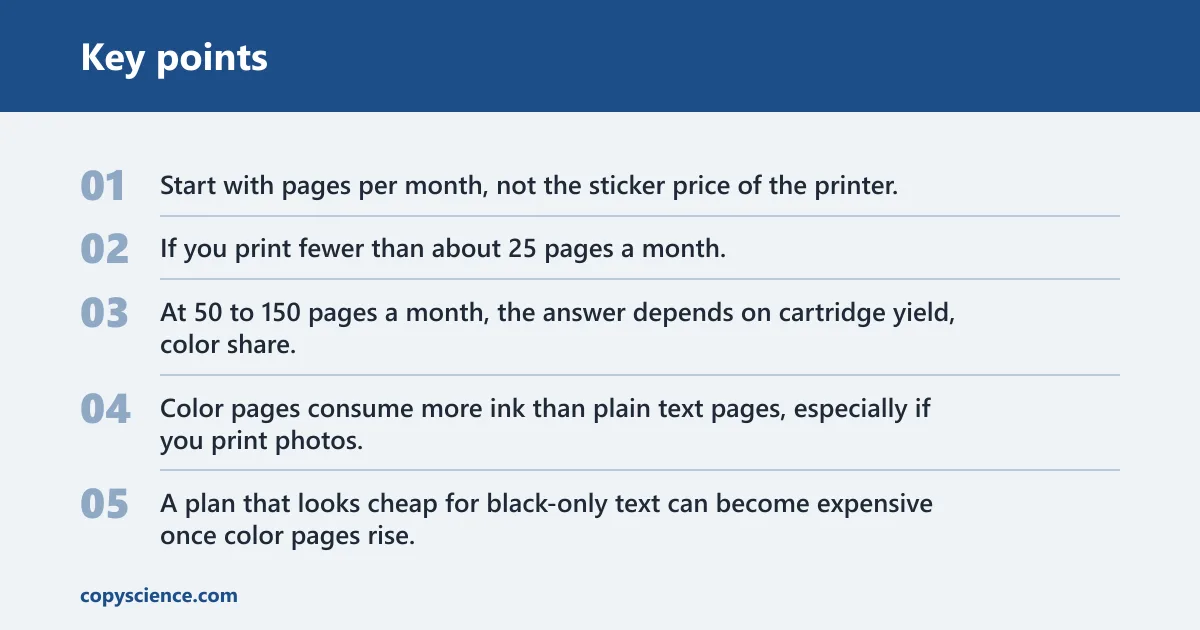
Start with pages per month, not the sticker price of the printer. If you print fewer than about 25 pages a month, a subscription often has little room to beat buying ink or toner as needed. At 50 to 150 pages a month, the answer depends on cartridge yield, color share, and whether the plan includes enough pages.
How color use changes the break-even point
Color pages consume more ink than plain text pages, especially if you print photos, school packets with charts, or slides with heavy graphics. A plan that looks cheap for black-only text can become expensive once color pages rise. If half your monthly pages are color, compare total cost per page, not just the monthly fee.
Where printer price fits in a 2- to 3-year comparison
Do not compare a low monthly fee with a one-time printer price and stop there. Compare the printer purchase price with the expected ink spend over about 24 to 36 months. A cheaper printer can cost more overall if its cartridges are small or expensive, while a pricier printer can win if its ink yield is better.
Printer cost matrix
This matrix gives a simple starting point. Treat it as a decision guide, not a quote, because cartridge yield, plan pricing, and color mix change the math. The general rule is simple: low volume usually favors buying ink as needed, while higher volume can favor a subscription if the page cap fits.
| Monthly pages | Color share | Household type | Usually cheapest ownership model |
|---|---|---|---|
| 0-25 | Mostly black text | Single user, occasional forms | Buy ink as needed |
| 25-75 | Low to moderate color | Small household, light school use | Usually buy ink as needed; compare against low-tier plans |
| 75-150 | Moderate color share | Family, school packets, homework printing | Either model; compare 2- to 3-year total cost |
| 150+ | Frequent color or graphics | Busy household, heavy home office use | Subscription may be cheaper if page caps fit and overages stay low |
Suppose a household prints 20 black pages a month and buys one cartridge every few months. A subscription can cost more than the ink itself, especially if unused pages expire. Now change only one variable: if that same home begins printing 12 color pages a month for school packets, a low page tier may stop being the best fit.
A common first-timer mistake is comparing the monthly fee to a single cartridge price. That misses the point. The real comparison is the printer purchase price plus 24 to 36 months of ink, page caps, and any overage or cancellation fees.
All printers require subscription worksheet
Use this worksheet to compare your own numbers. Fill in the printer price, cartridge price, cartridge yield, and any subscription fee. Then estimate a year of use and compare the totals. That gives you a cleaner answer than marketing claims or headline prices.
What numbers to collect
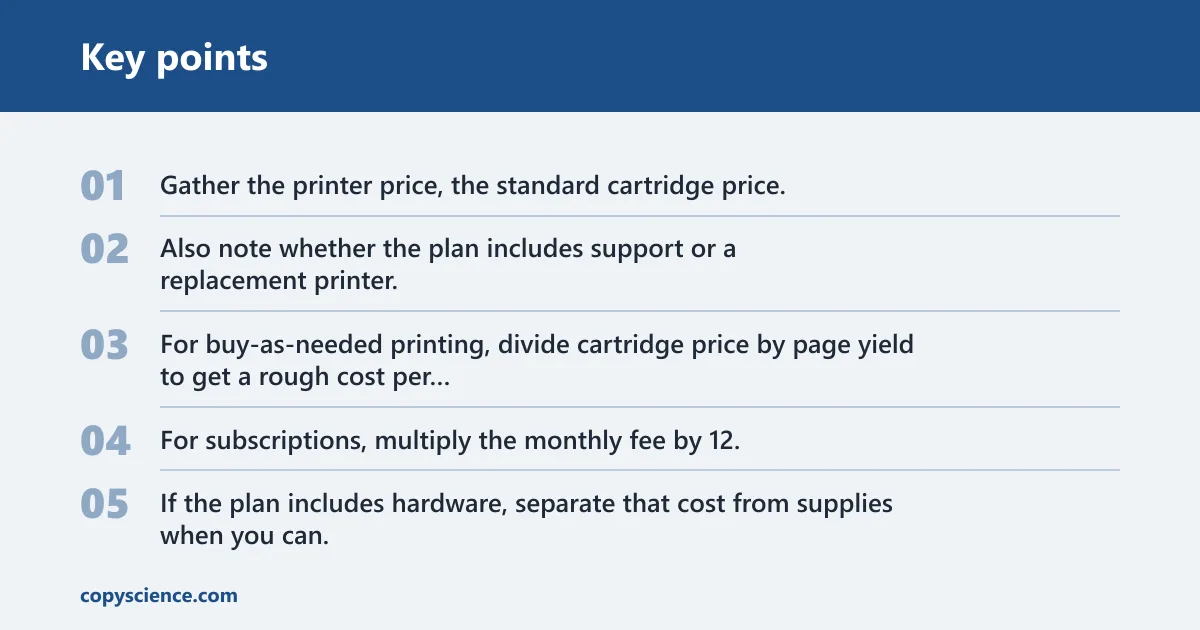
Gather the printer price, the standard cartridge price, the high-yield cartridge price if available, the stated page yield for each cartridge, the monthly subscription fee, the included page cap, and any overage fee. Also note whether the plan includes support or a replacement printer, because those extras affect value.
How to calculate ink spend
For buy-as-needed printing, divide cartridge price by page yield to get a rough cost per page. Then multiply by your expected annual pages. For subscriptions, multiply the monthly fee by 12, then add overage charges if your expected pages exceed the cap. If the plan includes hardware, separate that cost from supplies when you can.
How to compare plan cost with pay-as-needed cost
Use the worksheet below for a direct side-by-side estimate. If the subscription total stays lower over 12 months and the page cap fits your use, it may be worth it. If the retail total is lower, you can skip the plan and buy ink only when needed.
| Line item | Your number | Notes |
|---|---|---|
| Printer purchase price | __________ | One-time hardware cost |
| Standard cartridge price | __________ | Use if you buy cartridges as needed |
| Standard cartridge yield | __________ pages | Page yield from the manufacturer |
| High-yield cartridge price | __________ | Optional, if available |
| High-yield cartridge yield | __________ pages | Often lower cost per page |
| Monthly subscription fee | __________ | Recurring charge |
| Included pages per month | __________ pages | Page cap or usage limit |
| Overage fee | __________ | Charge for extra pages, if any |
| Expected monthly pages | __________ pages | Use your own print habit |
| 12-month subscription total | __________ | Fee x 12, plus overages |
| 12-month pay-as-needed total | __________ | Printer price plus ink use |
What should you check before buying?
Check the setup screens, app prompts, account requirements, warranty terms, and cancellation language before you buy. If you want to avoid subscriptions, confirm that the printer can print after basic setup without joining a plan. Also look for repair coverage, return shipping rules, and any contract term that could trap you in extra cost.
Setup screens, app prompts, and account steps
Some printers ask for account creation, cloud sign-in, or app installation before the first print. Others can be used locally after basic setup. Read the product page and setup guide for phrases like “required account,” “instant ink ready,” or “subscription eligible,” because those details hint at how tied the printer is to a plan.
Warranty, support, and repair coverage
Subscription plans may include warranty or support that retail purchases do not. That can matter if you want quicker replacement or help with print quality problems. Still, do not assume the extra coverage is free. Compare the monthly fee against the value of the support you would otherwise buy or do without.
Cancellation, return, and termination terms
Read the fine print for cancellation windows, return shipping charges, minimum terms, and early termination fees. A plan that looks cheap at signup can become expensive if it requires a long commitment or charges to send equipment back. If you want flexibility, choose a model that prints without a contract attached.
Frequently asked questions
Do all printers require a subscription, or can I buy ink as needed?
Most printers do not require a subscription. You can usually buy ink or toner as needed, and that is often the cheapest path for light users. A subscription only makes sense if your monthly page count is steady enough to fit the plan and its limits.
Can I use a printer without signing up for an ink plan?
Often yes, but not always without account setup. Many printers print fine after basic installation, while some models push app sign-in or supply enrollment during setup. Check the manual and product page before buying, especially if you want to avoid recurring billing or cloud-linked features.
What printers let me buy ink only when I need it?
Most standard retail inkjet and laser printers do. Look for models that sell replacement cartridges or toner at retail without requiring automatic enrollment. If the box or setup guide keeps mentioning monthly pages, auto-shipment, or managed supplies, the printer may be aimed at a subscription model.
Is an ink subscription cheaper than buying cartridges as needed?
Sometimes, but only when your monthly pages match the plan and you avoid overage charges. Low-volume users usually save by buying ink only when needed. Higher-volume users may benefit from predictable delivery if the subscription covers enough pages and includes useful support.
What are the hidden costs of a printer subscription?
Watch for overage fees, unused page loss, return shipping, early termination charges, and hardware bundles that raise the real cost. Some plans also require a working internet connection or app account. Warranty and support can add value, but only if you actually need those extras.
What should I check before buying a printer to avoid subscriptions?
Check whether setup requires an account, whether ink delivery is optional or required, whether firmware or app prompts block normal printing, and whether cancellation terms have fees. Also compare the printer price against 2 to 3 years of ink spend, since hardware cost alone does not show the full cost.